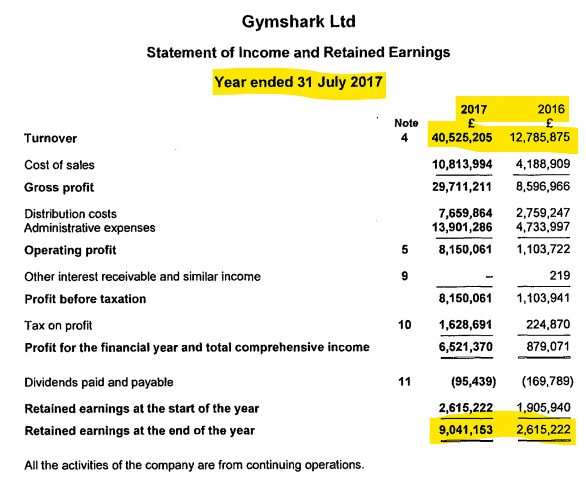
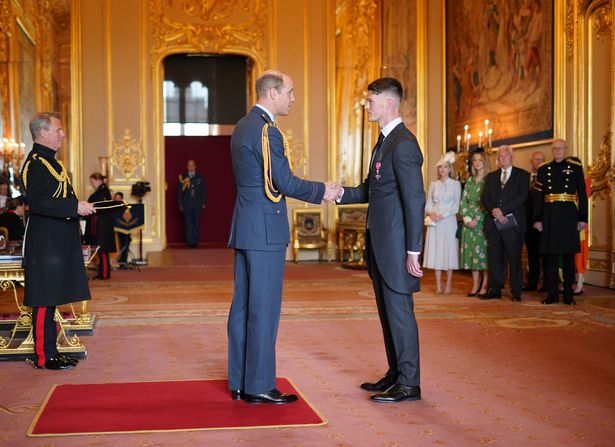
<?xml version="1.0" encoding="utf-8"?><feed xmlns="http://www.w3.org/2005/Atom" ><generator uri="https://jekyllrb.com/" version="4.4.1">Jekyll</generator><link href="https://andrewlynch.net/feed.xml" rel="self" type="application/atom+xml" /><link href="https://andrewlynch.net/" rel="alternate" type="text/html" /><updated>2026-06-23T15:31:40+00:00</updated><id>https://andrewlynch.net/feed.xml</id><title type="html">Andrew Lynch</title><subtitle>Personal blog of Andrew Lynch, finance professional and occasional writer.</subtitle><entry><title type="html">All self-help advice ever, distilled into ten sentences</title><link href="https://andrewlynch.net/blog/all-self-help-advice-ever-distilled" rel="alternate" type="text/html" title="All self-help advice ever, distilled into ten sentences" /><published>2026-01-09T00:00:00+00:00</published><updated>2026-01-09T00:00:00+00:00</updated><id>https://andrewlynch.net/blog/all-self-help-advice-ever-distilled</id><content type="html" xml:base="https://andrewlynch.net/blog/all-self-help-advice-ever-distilled"><![CDATA[<p><em><a href="https://andrewglynch.substack.com/p/all-self-help-advice-ever-distilled">Substack version</a></em></p>

<ol>
  <li>You are mortal and your time on Earth is limited.</li>
  <li>As a result, you must decide what is important to you, and ruthlessly prioritise those things, because you can’t do everything.</li>
  <li>You are the only person responsible for changing your life.</li>
  <li>If there is one silver bullet in life, it’s regular physical exercise, followed closely by a good diet and enough sleep.</li>
  <li>You probably know what it is that you should be doing, so do those things.</li>
  <li>To work out what you should be doing, ask yourself, “if a friend of mine was in the exact same situation as me, what advice would I give them?”</li>
  <li>You can change your life rapidly by changing your environment and who you surround yourself with, and removing self-limiting beliefs.</li>
  <li>To get different results to other people, you must do different things than other people.</li>
  <li>Success is not an event, it’s a process, and from the outside it looks like doing the boring fundamentals, diligently, repeatedly, and at high quality.</li>
  <li>And if you achieve ‘success,’ however you define that, you’ll realise that it’s always been about the journey anyway.</li>
</ol>]]></content><author><name></name></author><summary type="html"><![CDATA[Substack version]]></summary></entry><entry><title type="html">Debts and lessons</title><link href="https://andrewlynch.net/blog/debts-and-lessons" rel="alternate" type="text/html" title="Debts and lessons" /><published>2024-11-17T00:00:00+00:00</published><updated>2024-11-17T00:00:00+00:00</updated><id>https://andrewlynch.net/blog/debts-and-lessons</id><content type="html" xml:base="https://andrewlynch.net/blog/debts-and-lessons"><![CDATA[<p><em><a href="https://andrewglynch.substack.com/p/debts-and-lessons">Substack version</a></em></p>

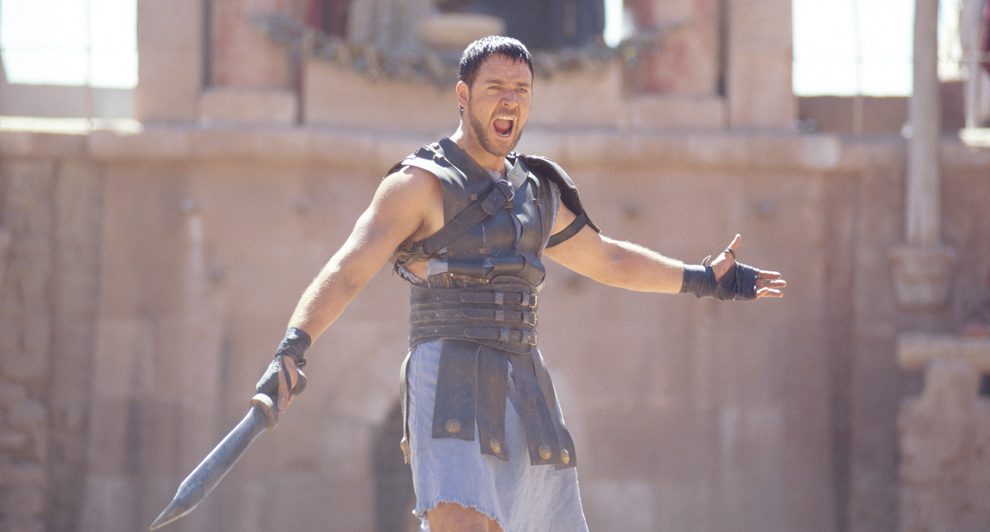
<p>If I could pick one movie to call my favourite — just one I had to single out, above all others — I’d probably pick <em>Gladiator</em>.</p>

<p>The incredible hero’s journey, the jaw-dropping fight scenes, the wide shots of a roaring colosseum. It’s all just wonderful.</p>

<p><img src="https://substack-post-media.s3.amazonaws.com/public/images/6f6df774-789e-4516-be9d-c28461a0e011_990x532.jpeg" alt="Gladiator" /></p>

<p><em>”Are you not entertained? If you are, don’t forget to like and subscribe, so you never miss a post.”</em></p>

<p>(Sidenote: I am writing this before I’ve had a chance to see *Gladiator II, *so at this point, my opinion of the original remains untarnished. TBD if that remains the case in a couple of weeks.)</p>

<p><em>Gladiator</em> was also the first time I ever came across the character of emperor Marcus Aurelius (played by Richard Harris), as a frail, ageing man who swiftly gets murded by his psychopathic son, Commodus (Joaquin Phoenix). Since the movie was released more than 20 years ago, Marcus Aurelius has seemingly become one of the most popular figures of ancient history, thanks to the burst of popularity of stoicism. Marcus’s book *Meditations *is a key stoic text, and one of very few that survives to this day.</p>

<p><em>Meditations</em> is a remarkable book in a number of ways. It’s a book that was never written for publication — it’s just a journal, a notebook, that shows the inner thoughts of the most powerful man in the world. Marcus ruled from 161 AD until his death in 180 AD, and it seems like Meditations was mostly written towards the end of that period. So the book is 2,000 years old, and yet the issues that Marcus is wrestling with seem remarkably modern: he’s constantly reminding himself to be more patient, to be less distracted, not to jump to judgment of others’ actions, to be calm in the face of adversity, and more. (Highly recommend it — get the <a href="https://amzn.to/3AOrRPd">Gregory Hays translation</a>.)</p>

<p>The first section of the book is titled <em>Debts and lessons</em>,in which Marcus lists the things he’s learned from family, friends and mentors over the years. “From Maximus: Self-control and resistance to distractions. Optimism in adversity. Doing your job without whining.” That sort of thing.</p>

<p>It’s fascinating, to realise all the people who influence your character, your thought patterns, your actions. All the tiny pieces of others that you’ve adopted and integrated into your own personality.</p>

<p>I decided to do this exercise myself, to document the lessons I’ve learned from other people I consider mentors and influences. Some of these people I’ve met; others, I’ve just read their books. Some are public figures, others are known only to a handful. I’ve only put their first name below, so I’ll leave it up to you to see which ones you think you can identify.</p>

<hr />

<h2 id="debts-and-lessons"><strong>Debts and lessons</strong></h2>

<p><strong>Joshua:</strong> the idea of “testable fluency in the basics.” Writing as a tool not just to showcase your work, but to document your life (and balancing that with family privacy). The ‘British’ method of measuring wealth via cashflow, rather than asset value.</p>

<p><strong>Tucker:</strong> how to write clearly. The importance of the first line. Turning me on to some remarkable examples of great writing. The value of a personal library of physical books. Operating with urgency and a bias towards action.</p>

<p><strong>Ryan:</strong> adopting reading as a way of life, particularly the classics. The person that introduced me to *Meditations *in the first place, among many, many other incredible books. The canvas strategy. The power of index cards, both as a to-do list method and as a commonplace book strategy. The importance of journaling. Deciding to deliberately seek and cultivate stillness in one’s life.</p>

<p><strong>Robert:</strong> the importance of seeing things how they really are, not as you simply want them to be. Reading far and wide, learning the timeless lessons of history. Being deliberate and thoughtful in your actions. Never outshining the master. Guarding your reputation with your life. How to persuade someone (by appealing to self-interest, never to duty or obligation).</p>

<p><strong>Nassim:</strong> the barbell strategy. Above all else, avoiding wipeout risk. Ensuring you have aligned incentives and skin in the game. Attempting not to be fooled by randomness.</p>

<p><strong>Cal:</strong> how to study properly, through active recall on index cards (index cards again! An invaluable tool), and the fact that intensity trumps quantity. In fact, this showed me that doing the right things in short bursts can be WAY more effective than grinding it out for hours. The call to not simply ‘follow your passion,’ but to treat one’s career like a craft, developing career capital and becoming so good they can’t ignore you. Do deep work. Spend time in the real world, with real people.</p>

<p><strong>Tim:</strong> as with Cal’s study strategies, the aim is to be effective, not efficient.</p>

<p><strong>Naval:</strong> impatience with action patience with results. Don’t just read new things all the time, the aim is to find the best 100 books and read them over and over again (the twist being that the best 100 books are different for everyone, so you need to find them).  Always be reading something. Avoid anger — it’s a hot stone you hold in your hand while you wait to throw it at someone. The importance of owning equity. Learning to build and learning to sell.</p>

<p><strong>Charlie:</strong> be an autodidact. Read from all disciplines and steal the best ideas in each. The best business books aren’t business books, they’re biographies and history books. Don’t seek to be brilliant, but rather to avoid being stupid. The importance of keeping your word and living up to what you’ve promised to other people.</p>

<p><strong>Jimmy:</strong> the knowledge that you can reinvent yourself. If you don’t like your path, just pick another one.</p>

<p><strong>Marcus:</strong> to make time for yourself. To stop being pulled in every direction by the whims and priorities of others.</p>

<p><strong>Lucius:</strong> the shortness of life. How to avoid being caught up with the madness of crowds. Facing up to — and indeed practising — what you’re afraid of, to show yourself that it’s not that bad.</p>

<p><strong>Damian:</strong> showed me that being good at one or two tools (in his case, Microsoft Excel and a couple of other things) is enough to build a successful career, as long as you always keep learning.</p>

<p><strong>Dean:</strong> a real-world example of testable fluency in the basics, quizzing me and drilling me on the fundamentals until I knew them by heart.</p>

<p><strong>Mike:</strong> how to manage up, and across. The importance of quality, in particular on first impressions. For taking a chance on me when you did. How to hold others to account: get buy-in on the plan, get crystal clear agreements up front, then relentlessly measure performance and follow up.</p>

<p><strong>Andy:</strong> getting the details right. Pride in your work. Showing me that part of a leader’s job is to shield your team from distractions, nonsense or internal politics.</p>

<p><strong>Steven:</strong> the mentality of turning pro. Giving me the language to talk about The Resistance, and how to face it.</p>

<p><strong>James:</strong> how to build your idea muscle, and adopting a daily practice to do so. How to blend ideas together (‘idea sex’) to come up with new and novel approaches.</p>

<p><strong>Austin:</strong> how to steal like an artist.</p>

<p><strong>Julie:</strong> strategic job-hopping, adopt the mentality of getting everything you can out of a role, and then idenitfying the right time to move on.</p>

<p><strong>Angela:</strong> how to have fun! How to be open, friendly, with deep empathy and genuine friendship for those around you, and how to open your home to those on your team.</p>

<p><strong>Emma:</strong> balance, how to be demanding and hold incredibly high standards, while also being liked (or at least respected). Being generous with your time for those early in their career, and showing them how to actively manage their career.</p>

<p><strong>Matt:</strong> the importance of focusing on the main thing. The power of relentless, daily progress towards that one goal, come what may.</p>

<hr />

<p>That’s not a fully exhaustive list — there are plenty of other things I’ve learned from other family, friends, etc — but as two of these mentors would remind me: you don’t have to share absolutely everything, and in fact, you should always say less than necessary…</p>]]></content><author><name></name></author><summary type="html"><![CDATA[What happens if you copy the habits of a Roman emperor?]]></summary></entry><entry><title type="html">You can’t miss a day</title><link href="https://andrewlynch.net/blog/you-cant-miss-a-day" rel="alternate" type="text/html" title="You can’t miss a day" /><published>2024-11-04T00:00:00+00:00</published><updated>2024-11-04T00:00:00+00:00</updated><id>https://andrewlynch.net/blog/you-cant-miss-a-day</id><content type="html" xml:base="https://andrewlynch.net/blog/you-cant-miss-a-day"><![CDATA[<p><em><a href="https://andrewglynch.substack.com/p/you-cant-miss-a-day">Substack version</a></em></p>

<p>This is the simple secret to high performance. Lacrosse player Paul Rabil, the Michael Jordan of his sport, describes the scene in his book <a href="https://amzn.to/4fh0jkr">The Way of the Champion</a>.</p>

<p>While still in high school, Rabil was at a lacrosse camp, listening to a talk from legendary coach Tony Seaman.</p>

<p>“Who here wants to play at a Division 1 School?”</p>

<p>Every single kid raised their hand.</p>

<p>“I’ll tell you how to do it,” he said. “And on top of it, I’ll tell you how to get a full scholarship to play at a college of your choice. Who here wants a full ride?”</p>

<p>Again, every hand went up.</p>

<p>Seaman continued, “It’s a simple formula. There’s one thing you have to do. From this day forward, through your senior year of high school, <strong>you have to shoot a hundred shots a day.</strong>”</p>

<p>“That’s it,” he said. “You shoot a hundred shots a day from now through your senior year of high school, I guarantee you will get a full scholarship to the Division 1 college of your choice.” It only takes 30 minutes or so. “Who here can find thirty minutes to take a hundred shots?” Again, every hand went up.</p>

<p>“Here’s the caveat,” Seaman said.</p>

<p><strong>“You can’t miss a day.”</strong></p>

<p>“Not a holiday. You can’t miss when it’s pouring down rain. You can’t miss because you had a game the night before—or the day of. You can’t miss a day because you’re on vacation. And if you can’t find a goal, make one up. <strong>You have to find a way.</strong>”</p>

<p>Rabil concludes:</p>

<p><em>I don’t know about the other kids, but I walked out of that auditorium and did what Coach Seaman said. Every single day, rain or shine, I practiced. Everywhere I went, I would find a wall to throw against. A goal to shoot on. From my home state of Maryland to New York, California, and Washington, to England, Italy, Spain, Israel, and France—me, a stick, and a ball.</em></p>

<p><em>For twenty years.</em></p>

<p>The result? Rabil was offered not one, but <strong>twelve</strong> full scholarships to top schools, won All-American honours four years in a row, and became the #1 draft pick, then played professional lacrosse for 14 years, winning two championships and, along the way, breaking the record for most career points, and reaching the pinnacle of his sport.</p>

<p>All from a hundred shots a day. A simple thirty minute commitment to practising your craft.</p>

<p>It doesn’t sound like a lot—and on any given day, it’s not. But brick by brick, slowly but surely, you’re building something. Over a year, you’ve made big progress. Over five years, you’re clearly pulling ahead of your peers. Over two decades, it’s completely life-changing.</p>

<p>It’s not easy, but it is simple.</p>

<p><em>Thanks to <a href="https://billyoppenheimer.com/">Billy Oppenheimer</a> for recommending this fantastic book. For more on this topic, I also love Steph Smith’s essay <a href="https://blog.stephsmith.io/how-to-be-great/">How to be great? Just be good, repeatedly</a>.</em></p>]]></content><author><name></name></author><summary type="html"><![CDATA[The secret to world-class performance]]></summary></entry><entry><title type="html">Comparison is the thief of joy</title><link href="https://andrewlynch.net/blog/comparison-is-the-thief-of-joy" rel="alternate" type="text/html" title="Comparison is the thief of joy" /><published>2024-10-22T00:00:00+00:00</published><updated>2024-10-22T00:00:00+00:00</updated><id>https://andrewlynch.net/blog/comparison-is-the-thief-of-joy</id><content type="html" xml:base="https://andrewlynch.net/blog/comparison-is-the-thief-of-joy"><![CDATA[<p><em><a href="https://andrewglynch.substack.com/p/comparison-is-the-thief-of-joy">Substack version</a></em></p>

<p>It feels odd being 35 and having a mildly successful career.</p>

<p>At this point in my life, I’m not sitting on a huge fortune, but I’ve got some good skills and experience. The last 10–15 years have been about learning, and now I’m starting to see the results. I’m happy with where I’m at.</p>

<p>And yet, I still catch myself comparing myself against others.</p>

<p>I see old classmates in dead-end jobs, whose careers have stagnated for a decade.</p>

<p>I see athletes I grew up idolising, who have all retired.</p>

<p>I see athletes my own age, praised for still playing at the top level “even at his age” — and with a hotshot 23 year old waiting to take their place.</p>

<p>I see entrepreneurs younger than me who’ve already made their fortune.</p>

<p>And I see peers in my field, some more successful, some not.</p>

<p>I compare myself to each of them, vacillating between feeling good about myself, and cursing the fact I’m not richer and more successful.</p>

<p>Then I realise: among every single one of those groups, there are people who are unhappy.</p>

<p>There’s a 45-year-old retired athlete, staring at his trophy cabinet, and wondering what his life means now that he doesn’t play.</p>

<p>There’s a 22-year-old phenom, struggling with the pressure of being hailed as the next big thing.</p>

<p>There’s a billionaire entrepreneur, on their third marriage, relationships the collateral damage business obsession.</p>

<p>On the other hand, there are happy people everywhere too. The former classmate in the so-called dead-end job might be blissfully content, doing a decent job, getting paid, and spending time with their family. The peer who topped out in middle management maybe just decided that was the right spot for them at that point in their life, with enough money to fulfil their obligations and needs, and they didn’t want the extra stress of more responsibilities.</p>

<p>Which means, comparing myself to those people is pointless. I can’t see the whole of everyone’s life. I can’t see what’s going on inside someone’s head to truly determine if they’re content with their lot.</p>

<p>The only person I can truly compare myself to is me. Am I growing in the direction I want to? Am I living by the values I claim to hold dear? Do I have people in my life that I love, and who love me in return?</p>

<p>And when I put my head on the pillow at night, am I happy with how I showed up in the world that day?</p>

<p>In the end, that’s really all that matters.</p>]]></content><author><name></name></author><summary type="html"><![CDATA[Just do you]]></summary></entry><entry><title type="html">Sometimes, life comes at you fast</title><link href="https://andrewlynch.net/blog/sometimes-life-comes-at-you-fast" rel="alternate" type="text/html" title="Sometimes, life comes at you fast" /><published>2024-05-04T00:00:00+00:00</published><updated>2024-05-04T00:00:00+00:00</updated><id>https://andrewlynch.net/blog/sometimes-life-comes-at-you-fast</id><content type="html" xml:base="https://andrewlynch.net/blog/sometimes-life-comes-at-you-fast"><![CDATA[<p><em><a href="https://andrewglynch.substack.com/p/sometimes-life-comes-at-you-fast">Substack version</a></em></p>

<p>Hello friends! As a reminder, you’re getting this because once, perhaps many moons ago, you found yourself on the <a href="https://andrewglynch.substack.com/">Substack page</a> of a somewhat charming British bloke called Andrew. Intrigued by this man’s way with words and eager to hear more, you thus gave up your email address, and in exchange, opted in to receiving new posts by email as and when they appeared.</p>

<p>Thanks for doing that! It’s likely that when you did, this newsletter was called <em>Human Capital</em>, an attempt to capture the fact that I’d be writing about business, finance, self-improvement, and a few other things.</p>

<p>A couple of things are changing:</p>

<h3 id="1-this-newsletter-is-now-a-2009-style-personal-blog"><strong>1) This newsletter is now a 2009-style personal blog.</strong></h3>
<p>[</p>

<p><img src="https://substack-post-media.s3.amazonaws.com/public/images/38aa0c28-4bb3-4ad5-9ba2-debb6dd699a4_1190x616.png" alt="" /></p>

<p>I miss the freedom of expression that used to exist in the blogosphere about 15 years ago. Just a bunch of people — not media companies, but real people — writing casually and regularly about what they were up to. I can never bring that era back, but I can do one small thing, which is be the change I want to see. So that’s what this newsletter is from now on: **a personal blog. **</p>

<p>You’ll hear from me on a completely unpredictable schedule, about what I’m working on, where I’ve been, the things I’ve learned, the places I’ve been, and more. If you don’t want that, that’s fine — feel free to unsubscribe.</p>

<h3 id="2-this-newsletter-is-now-called-off-the-books">2) This newsletter is now called <em>Off The Books</em></h3>

<p>Because everything needs a good name, and this is the best name that ChatGPT and I could come up — a name that reflects that I’m still a nerd who loves puns and accounting, but that this newsletter is now more informal, more casual, than other things <a href="http://netincome.co/">I sometimes write</a>.</p>

<p>With that out the way, I last wrote to this subscriber list a year ago. Here’s what been going on in the meantime — it’s a list of activity that should explain why I’ve not published anything recently.</p>

<h2 id="its-been-a-busy-year">It’s been a busy year</h2>

<p>An awful lot has happened in the last 12 months. I hadn’t realised quite how much until I sat down to write this, and reflected on where we were in April 2023. Here’s the rundown:</p>

<h3 id="i-started-a-new-job"><strong>I started a new job</strong></h3>

<p>This time last year I was working at a company I liked, with colleagues that I got along with, but in a role that had started to become stale. I’d been in that role for two years, and in that time, we’d made a ton of changes to improve the company. Most importantly, we implemented <a href="https://www.eosworldwide.com/what-is-eos">EOS</a>, which created a culture of ownership, accountability, and data-driven decision-making.</p>

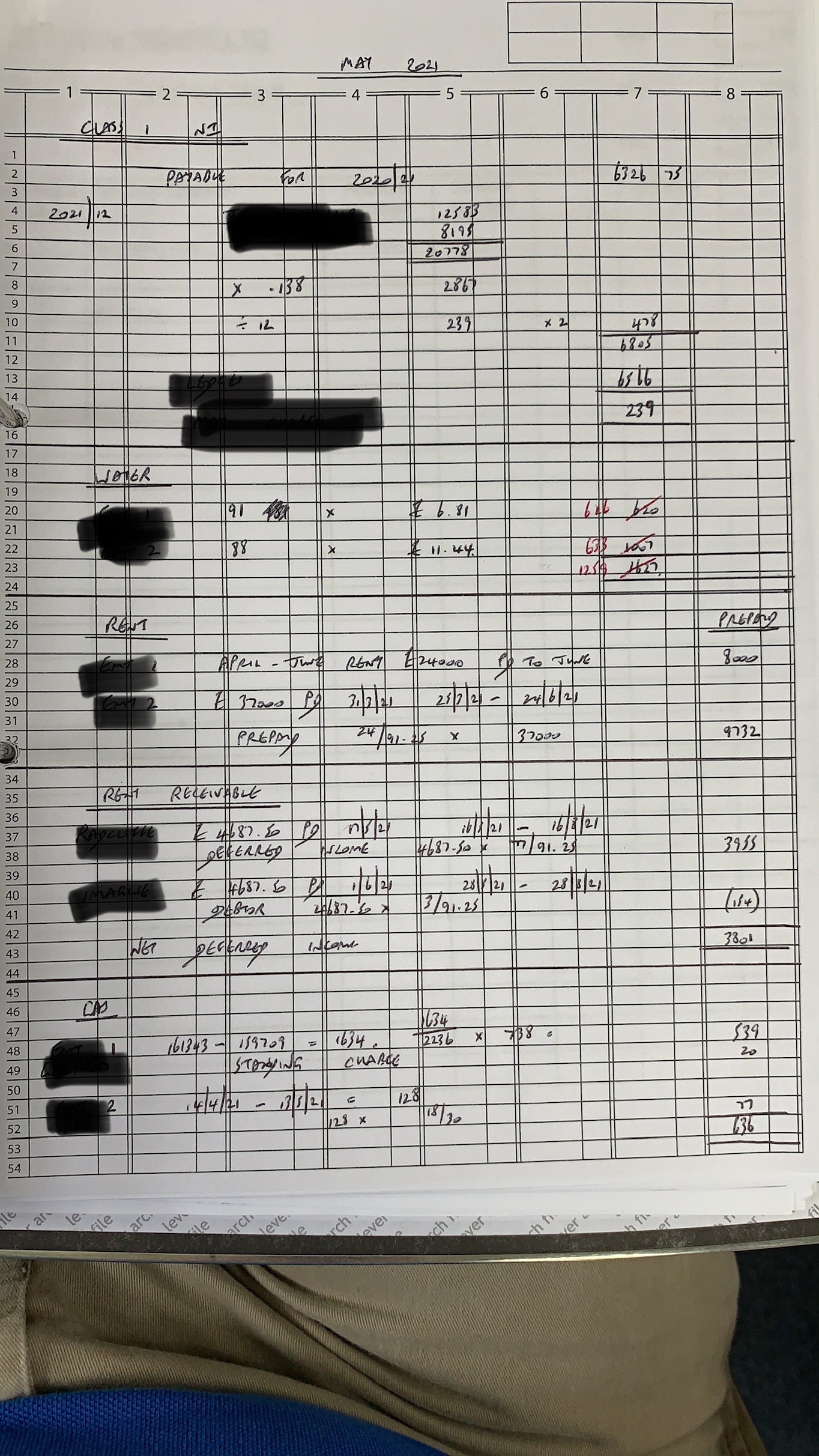
<p>I drove a bunch of changes in the Finance team specifically, taking them off the paper-based system the former Finance Director used — literally, here are some month-end calculations he used to work out accruals and prepayments:[</p>

<p><img src="https://substack-post-media.s3.amazonaws.com/public/images/9a728c9c-489b-40f4-86e6-98a4b93af029_1364x2424.jpeg" alt="" /></p>

<p>and implementing more automated, slicker processes, which also freed up some time to do a bunch more analysis and insight and figure out how we could drive bottom-line results.</p>

<p>Two years later, the company was improving and growing, and I was happy with the contribution I’d made, but I felt like my rate of learning had slowed down, and unless something changed, it would shortly be time for me to move on. I wrote a little more about that <a href="https://x.com/andrewglynch/status/1752734853093580995">here</a> if you’re interested.</p>

<p>So on a long car journey with my wife, we chatted about what my next role should be. After a decent amount of talking, we narrowed it down to:</p>

<p>-</p>

<h2 id="a-role-as-1-in-finance-or-2-if-the-company-is-bigger-and-the-cfo-is-someone-i-could-learn-a-lot-from">a role as #1 in Finance, or #2 if the company is bigger and the CFO is someone I could learn a lot from</h2>

<h2 id="ideally-in-the-tech-or-financial-services-industries">ideally in the tech or financial services industries</h2>

<h2 id="pe--or-vc-backed-high-growth-company">PE- or VC-backed high growth company</h2>

<h2 id="hybrid-with-no-more-than-3-days-a-week-in-office">hybrid with no more than 3 days a week in office</h2>

<p>doing something meaningful and positive for society</p>

<p>And when you make a specific ask, the universe answers. About 3 days later I got a call from a recruiter I knew from a prior role, who said she was hiring for a Head of FP&amp;A role at a high-growth, PE-backed tech company, working for a fantastic CFO, with 1-2 days a week in office.</p>

<p>Bingo. I went through the recruitment process, got the job, and started in November 2023.[</p>

<p><img src="https://substack-post-media.s3.amazonaws.com/public/images/cd93e219-bf60-49f1-9436-3fd89bf35fe7_1046x1090.png" alt="" /></p>

<p>Having been there for five months now, I can safely say, I love it. I’ll share more in another post, but for a number of reasons, this role felt like coming home. It’s fantastic.</p>

<h3 id="we-finally-finished-our-four-year-home-renovation-project">We finally finished our four-year home renovation project</h3>

<p>In June 2020, we bought our first house, a 110-year-old Victorian-style 4-bedroom semi here in Nottingham. It’s a beautiful house, but it was in a terrible state of disrepair when we bought it. The prior owners had both passed away, and I doubt they’d spent a penny on it in the last 30 years.</p>

<p>And now, we’ve finished it.</p>

<p>I say ‘finished’, but the homeowners among you know that no home is ever finished — like painting the Forth Bridge, once you’re done, you basically start again at the beginning — but we’ve now got to the point of having decorated every single room of the house, as well as the front and rear garden, in the last four years. Through painful issues with incompetent builders, battles with building control depts, and the literal theft of several thousand pounds of materials from one particularly unpleasant tradesperson, we’ve done it.</p>

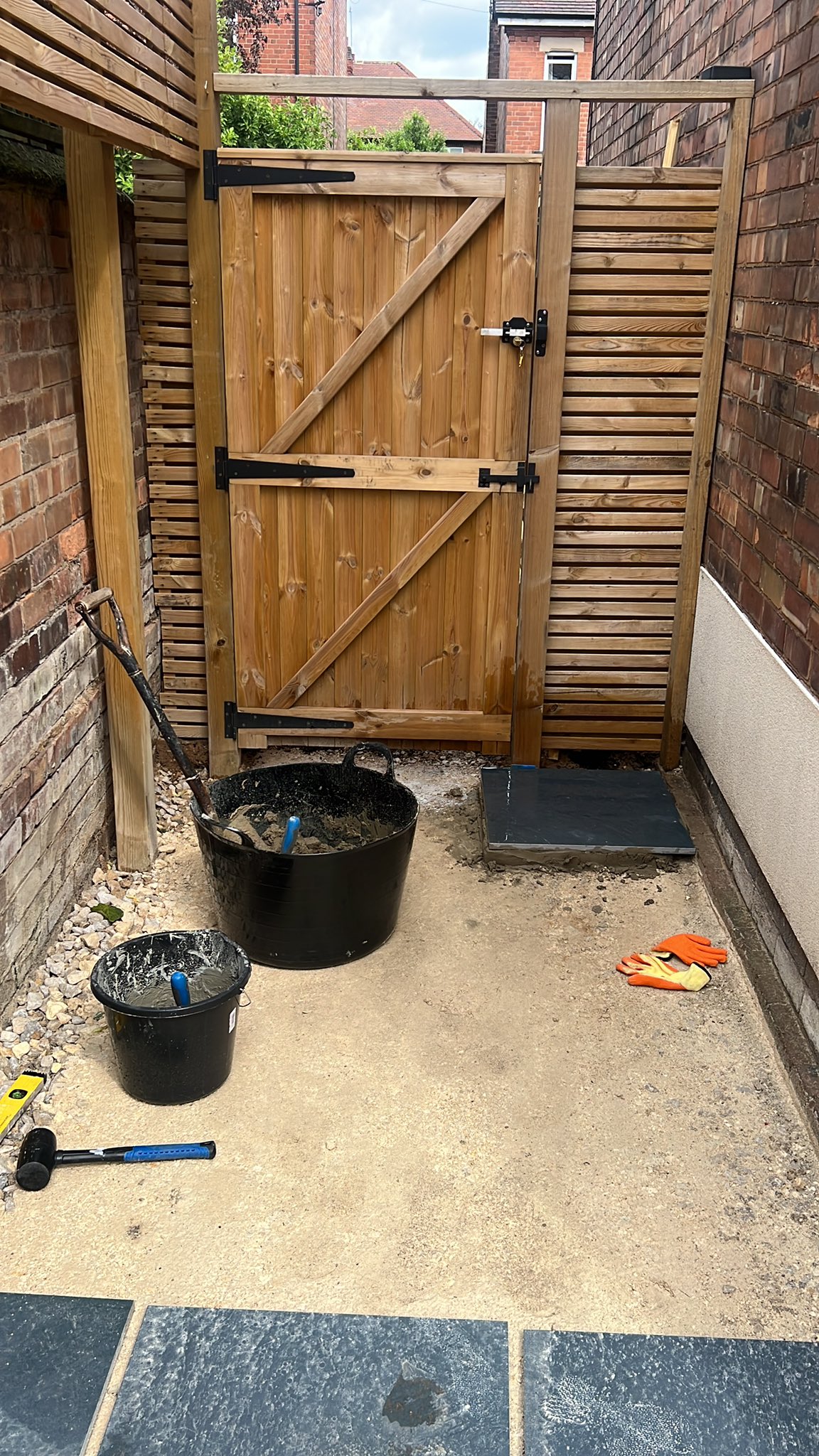
<p>Again, I’ll write more about this in future, but there’s such a tangible sense of achievement from doing things with your hands in the real world. When you spend your entire working week staring at a screen, manipulating numbers in spreadsheets, writing emails, or talking in endless Teams meetings, it can be hard to point to any real accomplishments. By contrast, when you’re doing renovation or construction work, you can point to the physical evidence of your work. In particular, doing this was incredibly satisfying:[</p>

<p><img src="https://substack-post-media.s3.amazonaws.com/public/images/60888f2d-63a0-4724-996f-626a951eab27_1536x2048.jpeg" alt="Image" /></p>

<p><img src="https://substack-post-media.s3.amazonaws.com/public/images/1c42a90f-b6e4-4a9f-9ef0-cd0578de89c5_1152x2048.jpeg" alt="Image" /></p>

<p><img src="https://substack-post-media.s3.amazonaws.com/public/images/b4283e91-822a-47fa-9871-3c33021c1764_1536x2048.jpeg" alt="Image" /></p>

<p>I dug all that out, put down all the rubble, compacted it, then mixed all the mortar, and laid the slabs down level. Later (not pictured), I also added grout, tidied it up, added stones down the side, and a little more. In his book Shop Class as Soulcraft, author Matthew Crawford writes:</p>

<blockquote>

</blockquote>

<p><em>The satisfactions of manifesting oneself concretely in the world through manual competence have been known to make a man quiet and easy.</em></p>

<p>He’s right. It’s been hard work but we’ve loved it — and now we have a beautiful house too. (More content <a href="https://www.instagram.com/notts_restoration/">on Instagram</a> if you want it.)</p>

<h3 id="we-went-on-a-cruise-around-the-mediterranean">We went on a cruise around the Mediterranean</h3>

<p>My wife and I felt like we wanted one last big holiday before the last thing on this list happened (see below), so in September we went on a cruise with Virgin Voyages around the Med, stopping in Barcelona, Marseille, Cannes, Mallorca, and Ibiza.</p>

<p>It was excellent. The food on board the ship was fantastic, we saw some beautiful cities, we enjoyed a day at a beach club in Cannes, and we went to see David Guetta in Ibiza. The only minor complaint was the lack of activity at the poker table on board, but aside from that, it was excellent all round.[</p>

<p><img src="https://substack-post-media.s3.amazonaws.com/public/images/4c16e09b-28ff-4ddc-a59e-d9808ae65a38_4032x3024.jpeg" alt="" /></p>

<p><img src="https://substack-post-media.s3.amazonaws.com/public/images/05fbba4e-27ae-4553-b910-b766d3da80f5_4032x3024.jpeg" alt="" /></p>

<p><img src="https://substack-post-media.s3.amazonaws.com/public/images/6aad0f6b-e298-4353-b85f-4065e0fbce2a_4032x3024.jpeg" alt="" /></p>

<p><img src="https://substack-post-media.s3.amazonaws.com/public/images/147b862c-3b9e-4a81-975d-041968dfeed7_4032x3024.jpeg" alt="" /></p>

<h3 id="we-had-a-daugher">We had a daugher</h3>

<p>Lastly, and most importantly, we welcomed our daughter into the world in April 2024.[</p>

<p><img src="https://substack-post-media.s3.amazonaws.com/public/images/58ba3f48-c6a5-44c7-a7a4-c49073e1bbb7_1094x1058.png" alt="" /></p>

<p>This general update post is already long enough, so I won’t go into all the details of what the pregnancy period and the first two weeks of parenthood have been like, but if you’re a parent, you already know. And if you’re not, then nothing I say can truly explain it. Which is the sort of annoying shit people used to say to me before I was a parent, but unfortunately, it’s 100% true. Suffice to say, I’m a very happy and proud #girldad.</p>

<h3 id="thanks-for-reading">Thanks for reading!</h3>

<p>Phew. What a year it’s been. Thanks for indulding me, and let me know what you’ve been up to as well. And if you want to follow me elsewhere, you can probably find me on LinkedIn, or find me on:</p>

<p>-</p>

<h2 id="twitter"><a href="https://twitter.com/andrewglynch">Twitter</a></h2>

<h2 id="instagram"><a href="https://www.instagram.com/andrewglynch">Instagram</a></h2>

<p>My other newsletter, <a href="https://www.netincome.co/">Net Income</a> (deep dives into interesting companies)</p>

<p>Speak soon.</p>]]></content><author><name></name></author><summary type="html"><![CDATA[What a year it's been]]></summary></entry><entry><title type="html">Not all EBIDTA is created equally</title><link href="https://andrewlynch.net/blog/not-all-ebidta-is-created-equally" rel="alternate" type="text/html" title="Not all EBIDTA is created equally" /><published>2023-10-06T00:00:00+00:00</published><updated>2023-10-06T00:00:00+00:00</updated><id>https://andrewlynch.net/blog/not-all-ebidta-is-created-equally</id><content type="html" xml:base="https://andrewlynch.net/blog/not-all-ebidta-is-created-equally"><![CDATA[<p><em><a href="https://netincome.substack.com/p/not-all-ebidta-is-created-equally">Substack version</a></em></p>

<hr />

<p><em>Hello! Welcome to the 603 new readers since last time out, joining our community of 2,532 business nerds.</em></p>

<p><em>As a reminder – it’s been a few weeks! — I’m Andrew Lynch, a small business CFO here in the UK. I love finding great companies and sharing their stories, and the lessons you can apply in your own company.</em></p>

<p><em>One favour to ask: if you like this, please share it with a friend.</em></p>

<hr />

<p><a href="https://www.netincome.co/p/the-niche-software-company-going">Last time out</a> we looked at **the Serif Group, **a wonderfully profitable niche software company, based in my home city of Nottingham, UK.</p>

<p>With zero outside funding and a small team of around 75 employees, they’ve managed to create a David of a software company that competes directly with the Goliath of creative tools, Adobe. It lets you create great art, like this:[</p>

<p><img src="https://substack-post-media.s3.amazonaws.com/public/images/e5ddced7-276d-4c7a-81d2-652e34ab62c8_2400x2000.jpeg" alt="Random splattering of geometric shapes layered around a drawing of a girl with two hair buns, popping the collar of her jacket" /></p>

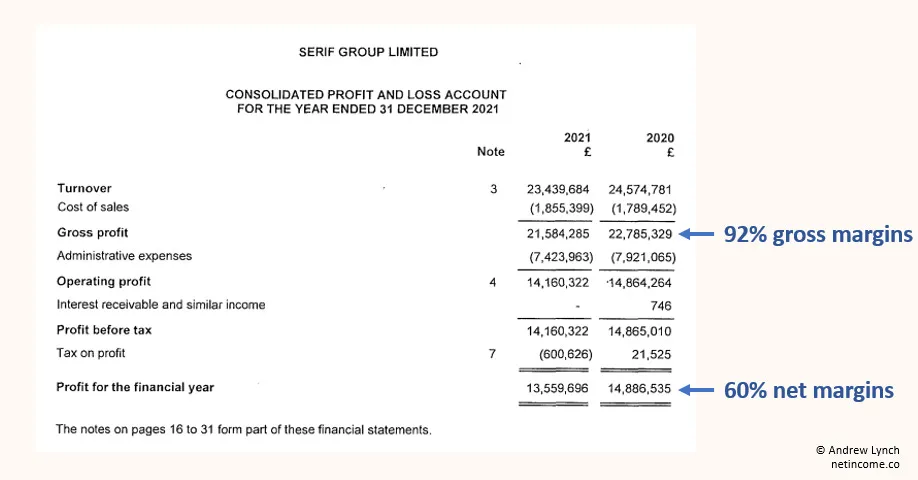
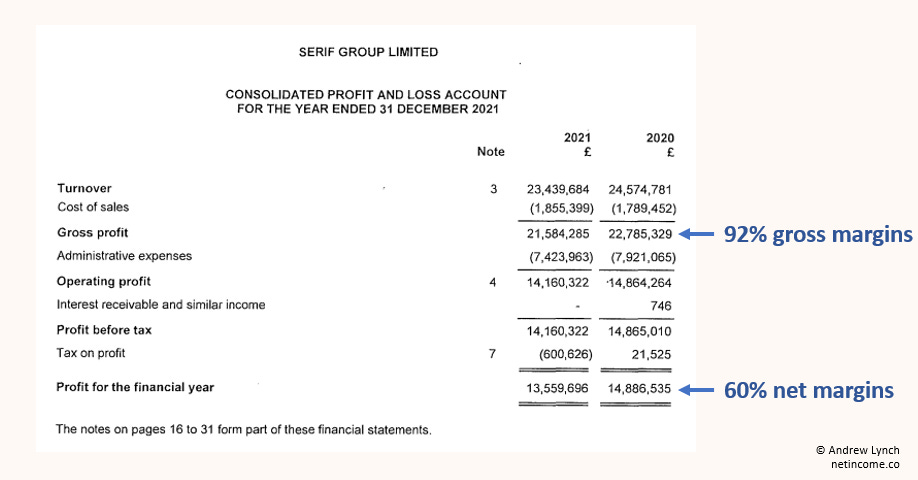
<p>Putting aside for a second the question of whether AI will completely destroy this industry, today Serif’s P&amp;L looks like this:[</p>

<p><img src="https://substack-post-media.s3.amazonaws.com/public/images/c17663b4-3306-4ac2-a7a3-17428f8bbc0a_918x480.png" alt="" /></p>

<obama_notbad.gif>

And more importantly, their cash flow statement looks like this:[

![](https://substack-post-media.s3.amazonaws.com/public/images/255cb6f5-94d6-4f2b-9f61-13b525e79605_741x820.png)

There is not a sweeter sight in the world than a company that has made £28m in operating cash flow in two years, and paid out basically all of it as dividends.

Because if there’s one thing that gets a CFO’s heart racing, it’s what my friend Secret CFO calls [Maintainable Free Cash Flow](https://x.com/SecretCFO/status/1570428046481432577?s=20), or MFCF.

Let’s do a quick primer for everyone out there and define some terms.

**Profit **is an accounting definition – when we’re talking about, say, net profit, we’re talking about total revenue, less all expenses, over a period of time.

Crucially, though, that profit figure could include a few important assumptions, like:

-

Depreciation charges
-

Amortisation charges
-

Accrued costs or income
-

Adjustments for prepaid revenue or expenses

which is why, in their books [Financial Intelligence for Entrepreneurs](https://amzn.to/46FIzdI)*, *the authors stress repeatedly that “profit is an estimate.”

Say it again. **Profit is an estimate.**

Profit is always an estimate, because the poor accountant preparing that profit figure never has perfect information. We can never know exactly the value of our fixed assets at any given time, so we use depreciation schedules to approximate it. We can never know exactly what this month’s energy bill will be until two weeks after the month-end close, so we accrue an estimate. And so on, and so on.

On the other hand, **cash flow** is known and knowable.

In a company’s financial statements, the cash flow literally represents the change in bank balance from the start of the year to the end of the year. If on Jan 1 your bank balance is £100,000, and on Dec 31 your bank balance is £200,000, then your cash flow for the year was £100,000, and no amount of accounting shenanigans can say otherwise.[1](#footnote-1)

## **So where does EBITDA come in?**

EBITDA stands for Earnings Before Interest, Taxation, Depreciation and Amortization. I enjoy standing on the shoulders of giants, so here’s a nice diagram from Secret CFO to show where EBITDA sits on the P&amp;L:[

![](https://substack-post-media.s3.amazonaws.com/public/images/e799f717-6956-4236-993f-8f137cd73d2d_574x766.png)

*Credit: [Secret CFO](https://x.com/SecretCFO/status/1565027791640444929?s=20)*

The idea of EBITDA was created by the CEO of TCI, John Malone, back in the 1980s.

Malone was an incredible entrepreneur, whose journey is chronicled in the wonderful book [Cable Cowboy](https://amzn.to/46BLPGZ). In the early 1970s, Malone saw that the cable industry:

1.

was growing rapidly rapidly growing;
2.

was fragmented across many providers; and
3.

had incredibly sticky customers willing to pay a lot for the service.

That led to Malone’s bold strategy: borrow lots of money to buy lots of cable franchises across the US, ensuring that the cash flow from each acquisition could cover the debt repayments on that asset. Over time, the debt would get paid down, the asset value would grow, and TCI’s shareholders – including Malone – would get very rich.

It’s a beautiful strategy. And it **worked like a charm.**

This strategy had one big downside though.

Acquiring cable franchises – and spending money on upgrading them – leads to big costs in your P&amp;L for **depreciation **and **amortization**.

How did Malone deal with that?

## **A brief sidebar on non-cash charges**

Depreciation and amortization are examples of **non-cash charges** in accounting. But what exactly are they?

**Depreciation **is the cost charge that goes in your P&amp;L when your physical assets go down in value.

The canonical example is a car. Let’s say you’ve invested £150k to start a private limo rental business. Your first step is to go and buy a brand-new limo for £100k exactly.

When you buy that limo, you’re exchanging one asset – cash – for another asset – a car. Here’s how that shows up on your balance sheet:[

![](https://substack-post-media.s3.amazonaws.com/public/images/a0ace892-bfa7-43e0-8b6c-d1f2044369c7_618x350.png)

The moment you drive it out of the limo dealership, assuming that’s a real thing, the car loses some value. That loss of value is the depreciation.

In this unfortunate example scenario, your fateful investment decision was on 1st March 2020, and thanks to Covid and your distinct lack of sales ability, you managed to go the whole year without ever making a single limo rental. Your limo, however, still lost a big chunk of its value. 25% of its value, in fact.[

![](https://substack-post-media.s3.amazonaws.com/public/images/fb0e758c-501d-45f5-b00a-aaf5d2790a6f_557x317.png)

Technically you’ve lost £25k. But your cash balance has stayed the same. The loss is due to the drop in the value of your asset. That’s a **non-cash expense **– but it’s still a real expense, because if you tried to sell that limo, you’d get less for it than what you paid.

Depreciation applies to physical assets. **Amortization **is exactly the same principle, but applied to **intangible assets. **Things like patents, licences, IP, trademarks, that sort of thing.

Let’s take your struggling limo rental company again. What if, in order to drum up business, you bribed a city official £20k to give you exclusive limo-operating rights for the next five years?

If you managed to stay out of jail, then that exclusive operating licence is an **intangible asset **with a life of five years – so the correct accounting treatment is to expense £4k per year to the P&amp;L, slowly reducing the value of that intangible asset over its five year useful life (and of course, if the city official ever goes to jail, write it down to zero).

Importantly, even though depreciation and amortization are non-cash charges, they are still tax-deductible.

Got it? Good. OK, back to the TCI story.

## **Malone’s wonderful strategy**

Chronicled in the wonderful book Cable Cowboy[link], Malone’s strategy was to borrow lots of money, and buy tons of cable franchises. Over time, the value of those franchises would go up. Those acquisitions also led to big interest charges (from the debt used in the acquisition), as well as large depreciation and amortization charges, all of which reduced TCI’s reported earnings, and therefore their tax bill.

Here’s a visual of the strategy:[

![](https://substack-post-media.s3.amazonaws.com/public/images/ccd872a3-b1bf-45b8-b90d-9d422bdc03da_1600x832.png)

In fact, such was Malone’s insistence on this strategy that he famously said to investors:

“If you’re going to ask about quarterly earnings, you’re at the wrong meeting, and you probably own the wrong stock. What we care about is value. We want to create value for our shareholders… **There is a big difference between creating wealth and reporting income.**”

And Malone threatened to fire the accountants if TCI ever reported a profit.

(NB please don’t do this, we need jobs now before AI takes them all, ty)

The downside of never reporting a profit is that investors back in those days – unlike the ZIRP-crazed investors we’ve seen in the last 15 years – liked to see a company actually making a profit. Will Thorndike talks about this in The Outsiders:

&gt;

*Malone [realized] that maximizing [reported] earnings… the holy grail for most public companies at that time, was inconsistent with the pursuit of scale in the nascent cable television industry. To Malone, higher net income meant higher taxes, and he believed that the best strategy for a cable company was to use all available tools to **minimize** reported earnings and taxes, and fund internal growth and acquisitions with cash flow…*

*While this strategy now seems obvious… at the time, Wall Street did not know what to make of it. In lieu of earnings… Malone emphasized cash flow to lenders and investors, and in the process, invented a new vocabulary, one that today’s managers and investors take for granted. Terms and concepts such as EBITDA were first introduced into the business lexicon by Malone.*

He *invented *EBITDA as a metric to give Wall Street something to focus on instead. It’s a proxy for operating cash flow.

Investors **loved** it. TCI got the funding it needed, and Malone repaid that investor trust was a wonderful success, returning on average more than 30% per year for 20 years, until Malone sold the business to AT&amp;T in 1999 for around $50bn. Not bad at all. And as Thorndike points out, he created the concept of EBITDA, which these days we take for granted.

But importantly, **not all EBITDA is created equally**. Malone used depreciation and amortization to reduce TCI’s tax bill, sheltering their earnings from the IRS. That’s good EBITDA. But you can imagine a

Depending on the characteristics of the company, £10m in EBITDA could result in lots of cash flow, no cash flow, or many things in between.

But what if you could cut out the middle step? What if you could just… pay less in taxes?

Which finally brings us back, for the last time, to Serif.

## **Sometimes tax policy is amazing**

Let’s look again at Serif’s P&amp;L.[

![](https://substack-post-media.s3.amazonaws.com/public/images/6e6080f5-ff16-403b-b66c-7581f9dbf63f_1343x693.png)

Out of £14.2m of pre-tax profit, their net profit was £13.6m. They paid just £600k in taxes – 4.2% of their pre-tax profit, at a time when UK corporation tax is supposed to be 19%. How on earth did they do that?

Two things:

### **1. R&amp;D tax credits**

Thanks to a wonderful bit of tax policy, if you go to the UK government and say, “I spent £1m on researching and developing new technology with an uncertain outcome,” they’ll say, “jolly good! Here’s £300k back. Thanks for doing your bit to support innovation.” It’s there to incentivise innovation and risk-taking, which it generally does.

That said, it’s a slightly grey area, which has unsurprisingly led to an army of grifters and consultants telling you they can get you tax credits for basically anything – for a fee. Sadly, I’m yet to find a consultant who can get me tax credits for a business-themed email newsletter. If you’re out there, please email me.

### **2. Reduced taxes on profits from patents**

If you’ve been reading Net Income for a while, you might remember the patent box from our post on [Petex](https://www.netincome.co/p/the-scottish-saas-business-with-71), another UK-based software company.

The ‘Patent Box’ – so-called because it’s literally a box on your tax return that you fill in – means that you only pay a rate of 10% corporation tax on any profits generated from patented IP.[

![](https://substack-post-media.s3.amazonaws.com/public/images/d4e0eb5a-1467-430a-b5ca-4880582c1ba7_644x185.png)

Let’s turn to the notes in Serif’s accounts:[

![](https://substack-post-media.s3.amazonaws.com/public/images/4d00c90a-53d6-4337-b8ef-56002f5680e7_709x469.png)

At usual rates, they would have paid £2.69m in tax. But thanks to £978k of R&amp;D tax credits, and £1.2m of patent box deduction, that £2.69m of tax becomes just £600k.

In fact, we can do some quick maths here:[

![](https://substack-post-media.s3.amazonaws.com/public/images/3d760ff1-0dcb-4234-a75d-926157fdee0a_558x250.png)

Serif is generating 94% of its pre-tax profit from patented IP – saving them a fortune** **in taxes.

## **This is why not all EBITDA is the same.**

All else being equal, you’d pay a higher EBITDA multiple for Serif than any other business.

Not because of any market dynamics, or unique customer relationships, or reputation in the market.

But because *you get to keep more of the profits*.

No marginal cost of goods sold. Infinitely replicable product, anywhere in the world. **And tax policy actively encourages this sort of risk-taking. **Software really is the best business model of all time.

And this is why Serif was such an amazing acquisition.

1.

Buy a business that’s generating residual cash flow from a legacy business.
2.

Re-invest significant portions of that into new software products, which generates significant tax credits in the process.
3.

If you create a great product, patent it and sell it and make loads.
4.

If you don’t, well, just enjoy the residual cash flow from the thing you bought.

Heads I win, tails I don’t lose too much. **A phenomenal value investment.**

Next time out we’ll look at another tech acquisition that was even better. In fact, our next analysis is on what’s probably the most profitable technology company in the UK. Keep an eye out for it in your inbox soon.

## **Carve outs**

-

I finally got round to reading [The 15 Commitments of Conscious Leadership](https://amzn.to/46m0DKg). I’m about 30% of the way in right now and it’s possible this will be a transformational book for me. More to come on this.
-

I read that book because Levels CEO Sam Corcos recommended it on [this podcast](https://tim.blog/2023/09/20/sam-corcos/) with Tim Ferriss. If you’re into business ops, efficiency and productivity, deep work, all that sort of stuff, you’ll love this interview.
-

If you want more about Levels, [this piece in the Generalist](https://www.generalist.com/briefing/levels) is well worth a read. The title, ‘A Cultural Anomaly’, hints at why they’re interesting. The piece opens: “There is not a company on earth that runs quite like Levels.”
-

Lastly, I’m starting a new professional opportunity shortly as Head of FP&amp;A for [Blue Light Card](https://www.bluelightcard.co.uk/), an amazing rocket ship of a business here in the UK. They have an incredible mission, and are assembling a top-tier team too. I can’t wait to get started — but fear not, Net Income will continue.
-

Lastly, I’m super-interested in what tech firms are using as their finance stack, so I’m doing some research and collating it all in one place. Here’s what I’ve got so far:[

![Image](https://substack-post-media.s3.amazonaws.com/public/images/a49b71b9-e999-414e-b891-2380a4f36731_1490x472.jpeg)

Thanks! Speak soon.

Andrew[1](#footnote-anchor-1)

This is also why one of the first things that auditors ask for in a financial audit is your bank statements. You can put an awful lot of nonsense through the P&amp;L, but unless you’re photoshopping your bank statements – which isn’t unheard of – then the bank statements are the ultimate truth.
</obama_notbad.gif>]]></content><author><name></name></author><category term="net-income" /><summary type="html"><![CDATA[TCI, Serif, and why tax policy is sometimes wonderful]]></summary></entry><entry><title type="html">A quick update on Net Income</title><link href="https://andrewlynch.net/blog/a-quick-update-on-net-income" rel="alternate" type="text/html" title="A quick update on Net Income" /><published>2023-09-01T00:00:00+00:00</published><updated>2023-09-01T00:00:00+00:00</updated><id>https://andrewlynch.net/blog/a-quick-update-on-net-income</id><content type="html" xml:base="https://andrewlynch.net/blog/a-quick-update-on-net-income"><![CDATA[<p><em><a href="https://netincome.substack.com/p/a-quick-update-on-net-income">Substack version</a></em></p>

<p>Hello! I hope you’ve had a wonderful summer, with plentiful cashflow and balance sheets that actually balance.</p>

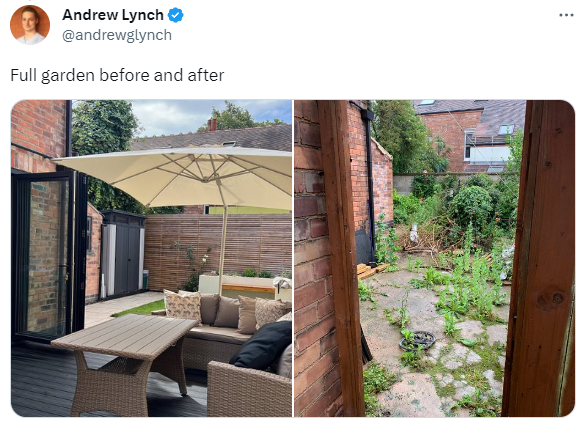
<p>A quick note from me: you might have noticed that in classic European style, I took a brief hiatus from Net Income over the summer. I’ve been busy sorting a new professional opportunity (more on that in the coming months), finishing our house renovation, and taking some well-needed rest. When I wasn’t working, exercising, or sleeping, I was doing my second job as an amateur landscaper to finally finish this beautiful deck:[</p>

<p><img src="https://substack-post-media.s3.amazonaws.com/public/images/1fb37614-2122-4a5a-aab4-c8af69653bde_2048x1152.jpeg" alt="Image" /></p>

<p>and here’s the full before and after for context:[</p>

<p><img src="https://substack-post-media.s3.amazonaws.com/public/images/b4d66c69-b866-4670-be6b-0c0bd4df304c_584x429.png" alt="" /></p>

<p>This has taken an awfully long time, but it’s totally worth it. It’s nice to actually create something with your own two hands — something you can see and touch, rather than just another spreadsheet or blog post.[</p>

<p><img src="https://substack-post-media.s3.amazonaws.com/public/images/eb1efe71-170c-43fa-9856-31c8833beb1d_680x382.jpeg" alt="Image" /></p>

<p>Finally, today my wife and I celebrate 5 years of marriage, and tomorrow we’re off on a week’s vacation. Please send me your book recommendations — just hit reply and let me know what you think I should read.</p>

<p>Net Income will return on <strong>September 15th</strong> to finish off our <a href="https://www.netincome.co/p/the-niche-software-company-going">Serif story</a>, before taking a detour into the world of — ahem — ‘adult entertainment,’ to look at one of the best acquisitions of all time.</p>

<p>Going forward, <strong>expect posts every two weeks.</strong> In my mission to be the perfect blend of the Acquired podcast and Wait But Why blog, I want to err on the side of quality over quantity. If you’ve read any of my earlier posts, you’ll appreciate the time and effort that goes into writing Net INcome (on the side of a full-time job). I don’t want to drop that quality bar just to hit an arbitrary, self-imposed weekly schedule — my mantra is less, better.</p>

<p>To tide you over until my return, you can visit the back catalogue. As a reminder, we’ve covered:</p>

<p>-</p>

<h2 id="petex-the-vertical-saas-company-doing-60-net-margins"><a href="https://www.netincome.co/p/the-scottish-saas-business-with-71">Petex: the vertical SaaS company doing 60% net margins</a></h2>

<h2 id="euroloo-the-1myear-portaloo-rental-business"><a href="https://www.netincome.co/p/making-a-million-pounds-from-dirty">Euroloo: the £1m/year portaloo rental business</a></h2>

<h2 id="baringa-scaling-a-consulting-biz-from-2m-to-200m"><a href="https://www.netincome.co/p/from-2m-to-200m-how-to-scale-a-people">Baringa: scaling a consulting biz from £2m to £200m</a></h2>

<h2 id="center-parcs-analysing-the-pe-structure-of-this-real-estate-and-hospitality-gold-mine"><a href="https://www.netincome.co/p/getting-price-gouged-by-private-equity">Center Parcs: analysing the PE structure of this real estate and hospitality gold mine</a></h2>

<h2 id="twinkl-the-best-info-product-business-ever-created"><a href="https://www.netincome.co/p/how-to-make-millions-selling-pdfs">Twinkl: the best info product business ever created?</a></h2>

<h2 id="how-rich-is-former-manchester-utd-footballer-gary-neville-really"><a href="https://www.netincome.co/p/is-this-guy-the-british-michael-jordan">How rich is former Manchester Utd footballer Gary Neville, really?</a></h2>

<h2 id="a-deep-dive-into-the-boardroom-drama-at-gymshark-part-1-and-part-2">A deep dive into the boardroom drama at Gymshark, <a href="https://www.netincome.co/p/the-boardroom-drama-behind-one-of">part 1</a> and <a href="https://www.netincome.co/p/gymshark-part-2-co-founder-exits">part 2</a>.</h2>

<p><a href="https://www.netincome.co/p/the-niche-software-company-going">Serif, the niche software company competing with Adobe</a></p>

<p>And if you want a little more, some supplementary reading:</p>

<p>-</p>

<h2 id="a-turnaround-story-from-my-own-career"><a href="https://www.netincome.co/p/hello-heres-a-get-rich-kinda-quick">A turnaround story from my own career</a></h2>

<p><a href="https://www.netincome.co/p/where-do-these-numbers-come-from">An intro to my research process for Net Income</a></p>

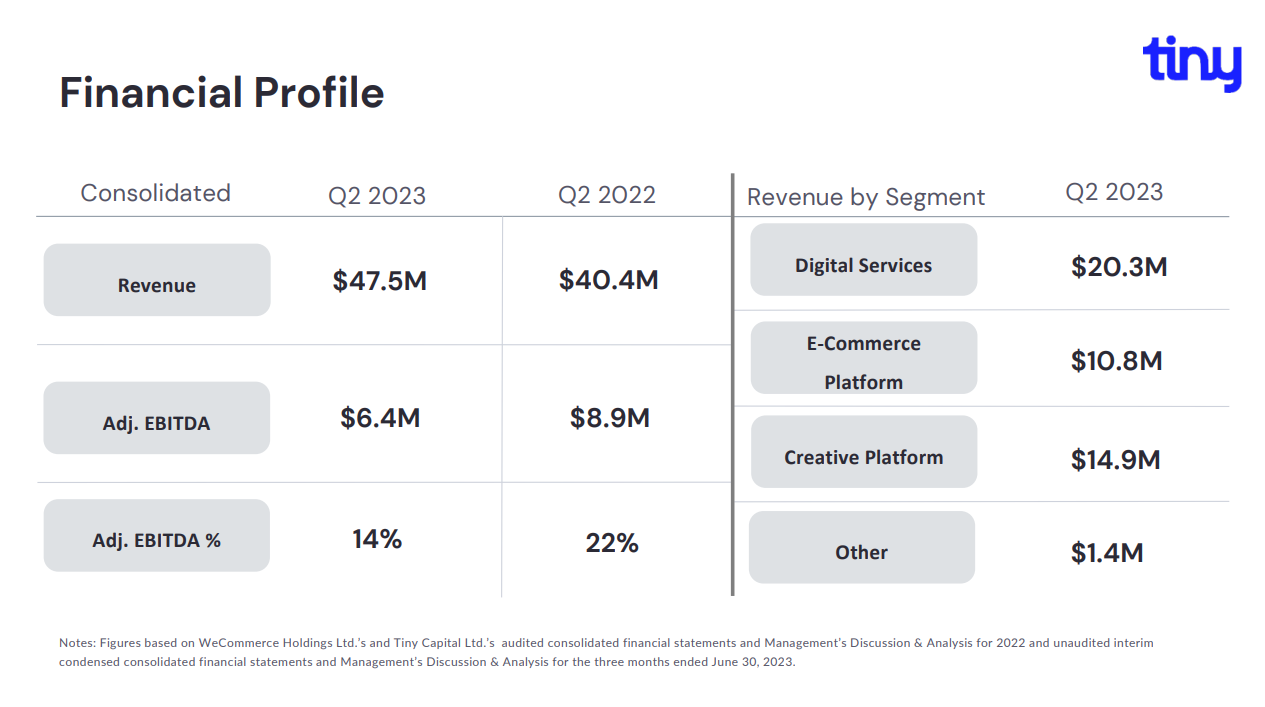
<p>Lastly, I’m a huge fan of entrepreneur <a href="https://twitter.com/awilkinson">Andrew Wilkinson</a> and his company <a href="https://www.tiny.com/">Tiny</a> Described as the ‘Berkshire Hathaway of the internet’, Andrew and his team have built a wonderful holding company which recently went public — which means all their numbers are now public. You can check out their latest investor presentation <a href="https://s202.q4cdn.com/676416790/files/doc_presentation/2023/08/TINY-Presentation-28-08-23.pdf">here</a>, which is well worth a read — they own Metalab, dribbble, Aeropress, girlboss and more, and the group now does around $150m a year of revenue at ~20% EBITDA margins:[</p>

<p><img src="https://substack-post-media.s3.amazonaws.com/public/images/893d6cec-8832-46e6-82e5-422d637c6292_1265x707.png" alt="" /></p>

<p>which is fairly stunning for a company that <a href="https://twitter.com/awilkinson/status/1649139599854440449?s=20">started as a web design agency back in 2006</a>. Andrew’s journey is an inspiration to me — who knows, maybe one day we’ll look back on Net Income as the start of my media empire.</p>

<p>As always, I genuinely, deeply appreciate your support for Net Income — writing and sharing this is a blast for me, and you taking the time to read it means the world to me.</p>

<p>Speak soon.</p>

<p>Andrew</p>

<h2 id="carve-outs"><strong>Carve outs</strong></h2>

<p>-</p>

<h2 id="i-loved-this-podcast-from-the-acquired-guys-about-costco-their-business-model-is-wonderful--for-more-check-out-this-incredible-deck-that-dives-deep-into-the-strategy-business-model-and-financials--market-comps">I LOVED <a href="https://www.acquired.fm/episodes/costco">this podcast</a> from the Acquired guys about Costco. Their business model is wonderful — for more, check out <a href="https://minesafetydisclosures.com/blog/2018/6/18/costco">this incredible deck</a> that dives deep into the strategy, business model, and financials / market comps.</h2>

<h2 id="i-get-asked-all-the-time-if-theres-a-uk-based-accounting-firm-i-can-recommend-for-small-businesses-ive-never-had-a-good-answer--until-now-the-company-is-ashton-mcgill-run-by-my-friend-jared-cordner-no-affiliate-relationship-they-just-put-more-focus-on-customer-experience-than-any-accounting-firm-ive-seen-before">I get asked all the time if there’s a UK-based accounting firm I can recommend for small businesses. I’ve never had a good answer — until now. The company is <a href="https://www.ashtonmcgill.com/">Ashton McGill</a>, run by my friend <a href="https://twitter.com/Jared_Cordner">Jared Cordner</a>. No affiliate relationship, they just put more focus on customer experience than any accounting firm I’ve seen before.</h2>

<p>I’m getting back into chess — far and away the best and most entertaining resource for improving is GM <a href="https://www.youtube.com/@DanielNaroditskyGM">Daniel Naroditsky</a>. Daniel has created several ‘speedruns’ where he plays at every rating level from true novice (ELO rating of ~ 500) up to master level (ELO rating of ~2200), and explains how to master the game at each level. Fascinating to watch, and Daniel’s a great teacher.</p>]]></content><author><name></name></author><category term="net-income" /><summary type="html"><![CDATA[Scheduling a return in two weeks]]></summary></entry><entry><title type="html">The niche software company going toe to toe with Adobe</title><link href="https://andrewlynch.net/blog/the-niche-software-company-going" rel="alternate" type="text/html" title="The niche software company going toe to toe with Adobe" /><published>2023-07-23T00:00:00+00:00</published><updated>2023-07-23T00:00:00+00:00</updated><id>https://andrewlynch.net/blog/the-niche-software-company-going</id><content type="html" xml:base="https://andrewlynch.net/blog/the-niche-software-company-going"><![CDATA[<p><em><a href="https://netincome.substack.com/p/the-niche-software-company-going">Substack version</a></em></p>

<hr />

<p><em>Hello to the <strong>165 new subscribers **this week,</strong> **bringing our motley crew up to **1,929 **balance sheet groupies for this week’s Net Income. I’m Andrew Lynch, a small business CFO and writer here in the UK</em></p>

<p><em>Two things this week:</em></p>

<p>1.</p>

<p><em>Yes, you’re receiving this on a Sunday, not a Thursday — you have not time-travelled, life just got in the way. C’est la vie.</em>
2.</p>

<p><em>We now have a shiny new domain name, <a href="https://www.netincome.co">NetIncome.co</a>, where you can head to for all of the archive.</em></p>

<p><em>As always: if you like this, <strong>please share it</strong> with a friend.</em></p>

<hr />

<p>If there’s one thing that Warren Buffett and I have in common, it’s our love of cheeseburgers.</p>

<p>But if there are two things that Warren and I have in common, the second is that we both rue our **mistakes of omission. **We regret the mistakes from actions not taken.</p>

<p>Warren, for example, kicks himself for not investing in companies he fully understood and knew to be a great investment at the time: Disney, Walmart, Fannie Mae, to name but a few.</p>

<p>And me? In 2011 I interviewed at a large institutional investment company, and as part of the interview process, they asked me to recommend some investments.</p>

<p>My two recommendations were:</p>

<p>1.</p>

<p>Google
2.</p>

<p>Apple</p>

<p>I gave a good justification for why: both dominant in their respective markets, both producing high-quality revenue, both benefiting from growing smartphone adoption. The interviewers agreed, although not enough to give me the job.</p>

<p>I promptly went away and did… <strong><em>nothing.</em></strong></p>

<p>In my defence, from its IPO date to the day I recommended that investment, Google stock was up 5x in seven years, and the market cap was $166bn on $8.5bn of net income, a P/E ratio of 19.5. It looked a bit frothy to me.</p>

<p>Since then, <strong>Google stock is up 9.2x in 12 years</strong>, a 20.3% annual return. (I don’t want to know the numbers for Apple.)</p>

<p>In 2011 Google did $38bn of revenue, and $8.5bn of net income, so a net margin of 22%.</p>

<p>In 2022, Google (rebranded, for some reason, as Alphabet) did $280bn of revenue, generating $60bn of net income — still <strong>21% net margins</strong>, even at that scale.</p>

<p>That’s despite funding all manner of speculative R&amp;D projects,<a href="https://twitter.com/andrewglynch/status/1577269044817715204?s=20"> poorly executed product launches</a>, and much more (does anyone know what Google Hangouts is called these days?).</p>

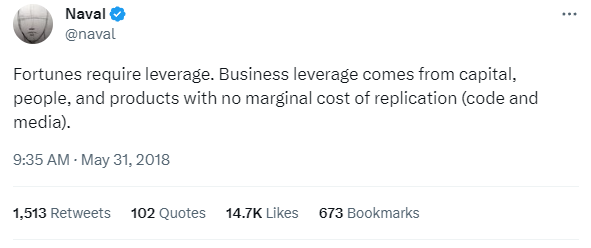
<p>They can generate a spectacular amount of cash because **software is the best business model of all time. **</p>

<p>It’s a model built on a mountain of leverage, as defined by the angel-investor-turned philosopher Naval Ravikant.[</p>

<p><img src="https://substack-post-media.s3.amazonaws.com/public/images/b261bb92-fb41-4a00-a440-e923390e707d_591x248.png" alt="" /></p>

<p>With zero marginal cost of replication, you can build something once — like a great search engine with real-time ad auctions built in, or a <a href="https://www.netincome.co/p/the-scottish-saas-business-with-71">petroleum-industry vertical market software product</a> — and serve it up to your customer again and again at virtually zero incremental cost. Serving one customer costs practically the same as serving thousands of customers.</p>

<p>(and if you don’t have the ability to make software, you can do something with equal amounts build-once-sell-many-times leverage, like, y’know, a newsletter)</p>

<p>Today’s company is not at the same scale as Google — because very few companies are — but is a phenomenal example of software leverage even at a small scale.</p>

<p>This is the <strong>Serif Group</strong>:[</p>

<p><img src="https://substack-post-media.s3.amazonaws.com/public/images/245ed1c5-4646-44a6-8aca-d6b7149271e8_918x480.jpeg" alt="" /></p>

<p>This is a niche software company in my home city of Nottingham, UK, and they are generating £14m of net income per year, on revenue of around £24m per year, giving them <strong>net margins of around 60%</strong>.</p>

<p>What are they selling? How did they get here? And why do they pay so little in tax? All this and more in today’s newsletter.</p>

<hr />

<p>*This week’s Net Income is brought to you by <a href="https://www.nextscout.co/">NextScout</a>. NextScout connects executives with highly skilled overseas talent, talent that costs 75% less than a US or UK equivalent. *</p>

<p><em>Unlike other recruitment services, you only pay <a href="https://www.nextscout.co/">NextScout</a> when you hire a remote worker who meets your standards — which, thanks to their **rigorous candidate selection process, **is a near-certainty.</em></p>

<p><em>Not sure what tasks to delegate? NextScout have put together <a href="https://www.nextscout.co/post/list-of-tasks-you-can-outsource-to-remote-workers">this guide</a> to help you get started.</em></p>

<p><em>So if you want to reduce your labour cost, NextScout can help. Just fill out this <a href="https://www.nextscout.co/contact-us">short form</a>, and they’ll take care of the rest.</em></p>

<hr />

<h2 id="who-are-the-serif-group"><strong>Who are the Serif Group?</strong></h2>

<p>Founded in 1987, Serif Group to day is the publisher of three core apps across Windows, macOS and iOS:</p>

<p><strong>1) Affinity Designer</strong>[</p>

<p><img src="https://substack-post-media.s3.amazonaws.com/public/images/318fe4c9-ac65-4c00-a535-a5c03aeaaec8_1456x675.jpeg" alt="" /></p>

<p><strong>2) Affinity Photo</strong>[</p>

<p><img src="https://substack-post-media.s3.amazonaws.com/public/images/90ee6809-b572-4fbf-b906-49ac98127083_1456x696.jpeg" alt="" /></p>

<p><strong>and 3) Affinity Publisher</strong>[</p>

<p><img src="https://substack-post-media.s3.amazonaws.com/public/images/84648413-2cc4-40cb-8c8d-2ecd1be73723_1456x682.jpeg" alt="" /></p>

<p>In other words, they’re a direct competitor to Adobe’s creative cloud suite of Photoshop and InDesign.</p>

<p>You’d think that taking on one of the biggest and best-known software companies in the world would make things difficult.</p>

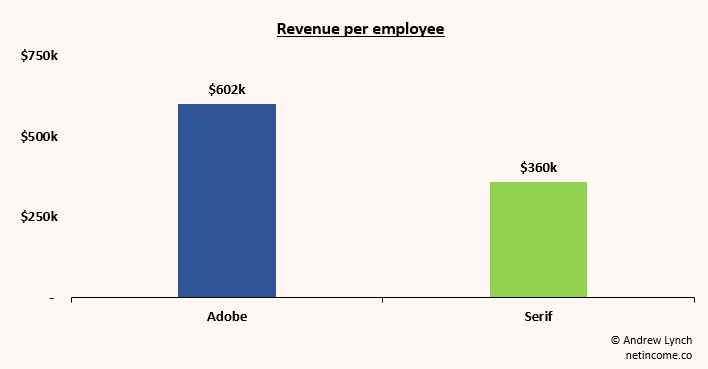
<p>But while Adobe does have significantly higher revenue per employee:[</p>

<p><img src="https://substack-post-media.s3.amazonaws.com/public/images/20e7fada-7a96-401b-8a26-7fba1797320a_708x369.png" alt="" /></p>

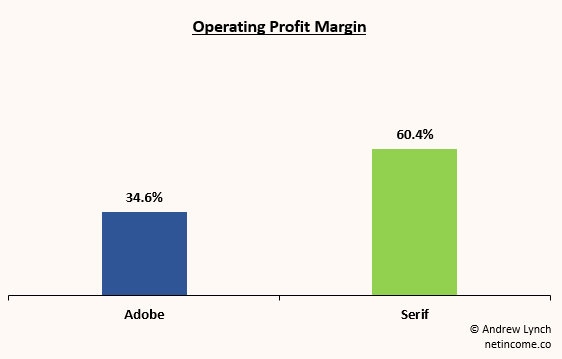
<p>…Serif actually has better operating margins than Adobe, albeit on a fraction of the revenue:[</p>

<p><img src="https://substack-post-media.s3.amazonaws.com/public/images/2657bd32-14df-4805-a9cd-d74d9314d8e0_562x359.png" alt="" /></p>

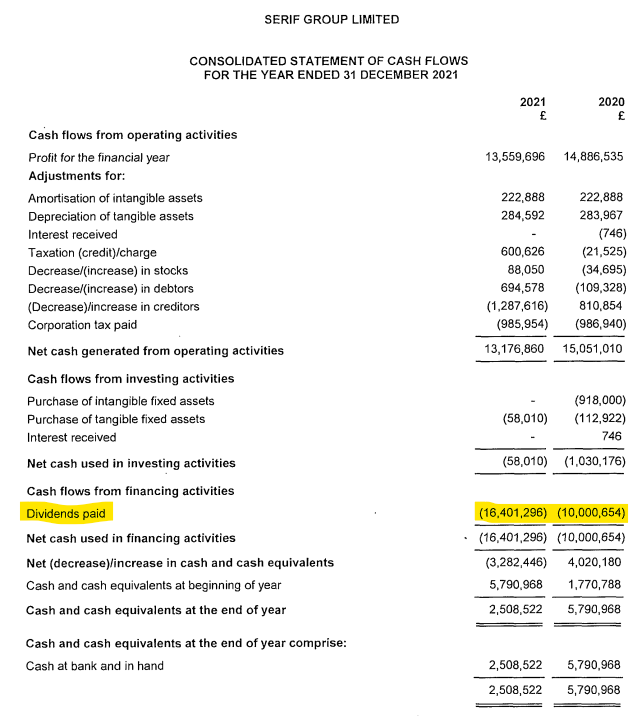
<p>And still — who cares if you’re not the size of Adobe when your shareholders are getting rich? They’ve paid out £26m in dividends in the last two years:[</p>

<p><img src="https://substack-post-media.s3.amazonaws.com/public/images/119a560d-aa27-4658-8945-843ffa18a7d1_629x716.png" alt="" /></p>

<p>So the Serif shareholders aren’t “private jet” rich, but having driven past their offices, they’re certainly “Porsche with private number plate” rich, and we all know that basically everything after that is just vanity money.</p>

<p>There are some key lessons to learn from the Serif story, which I’ll share next week. First, though, they’re a great excuse to do some *investment analysis *and break out the XIRR formula and some discount factor tables.</p>

<h2 id="lets-analyse-an-investment"><strong>Let’s analyse an investment!</strong></h2>

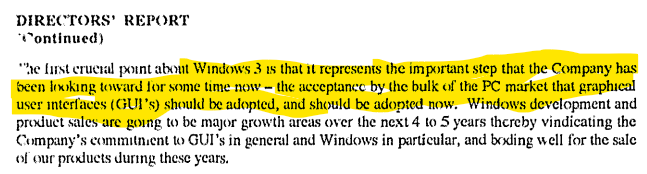
<p>Serif started out as a software and hardware reseller. Founded in 1987, its early filings contain wonderful passages like this a glimpse into what the tech industry used to be like — celebrating the widespread adoption, at last, of GUIs as a way of doing business:[</p>

<p><img src="https://substack-post-media.s3.amazonaws.com/public/images/e6b604a9-7a5e-4095-b153-6e4808537721_647x174.png" alt="" /></p>

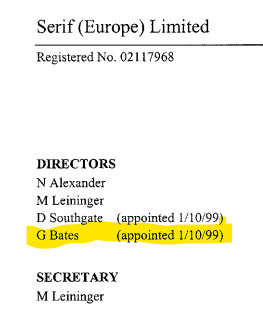
<p>Capitalising on these industry shifts, Serif grew steadily throughout the 1990s, selling a combination of hardware and software to UK businesses, until 1999, when a chap by the name of Gary Bates was appointed to the Board of directors:[</p>

<p><img src="https://substack-post-media.s3.amazonaws.com/public/images/f17c3e99-3f76-4292-8ba4-c0fa69380a89_263x319.jpeg" alt="" /></p>

<p>At this point the company was doing about around £6-10m per year in revenue, with some good years, some bad years.</p>

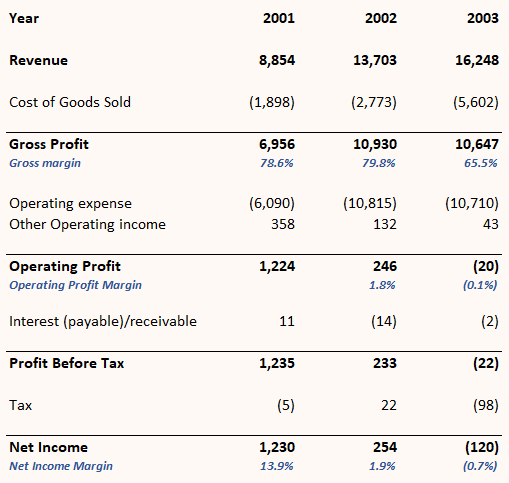
<p>By early 2004, the company had grown top-line revenue significantly, but that wasn’t translating into bottom-line profits: [</p>

<p><img src="https://substack-post-media.s3.amazonaws.com/public/images/3698e134-2f3f-454a-b6a4-f156abb97df2_509x483.png" alt="" /></p>

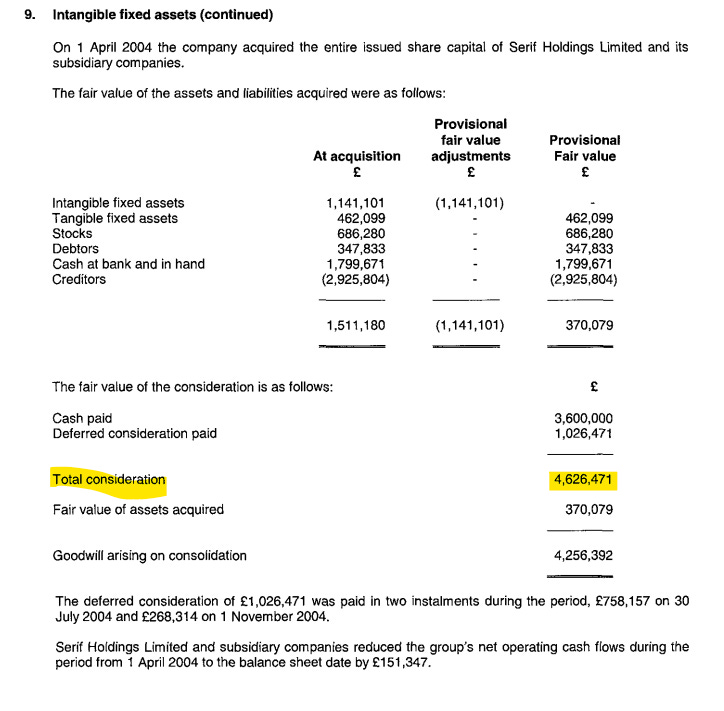
<p>So, sensing an opportunity, Gary Bates and his business partner James Bryce took a bold swing, and **bought the company **in a management buy-out, for £4.6m:[</p>

<p><img src="https://substack-post-media.s3.amazonaws.com/public/images/34899db2-f4b8-4b69-aeb3-2b4b475dae09_724x711.jpeg" alt="" /></p>

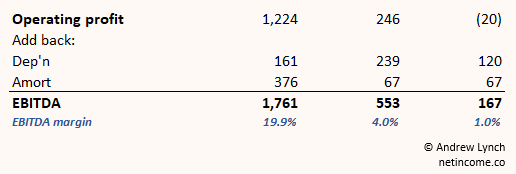
<p>Now, £4.6m seems punchy when the **total **net income of the company over the prior three years was only £1.4m. In fact, I went through the filings and calculated the EBITDA for the 2001-2003 period:[</p>

<p><img src="https://substack-post-media.s3.amazonaws.com/public/images/a72a38d5-0a47-4787-8cd7-6717b8ba5929_516x174.png" alt="" /></p>

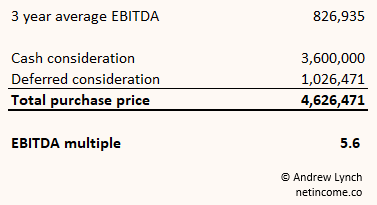
<p>Average EBITDA over this period was £827k, meaning that on a total purchase price of £4.6m, they paid a 5.6x EBITDA multiple to acquire a fairly middling business:[</p>

<p><img src="https://substack-post-media.s3.amazonaws.com/public/images/4a46a79d-b589-438e-9ce8-a51d6c64f51a_377x205.png" alt="" /></p>

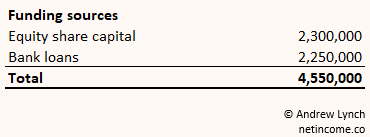
<p>One important point to note here is that the acquisition was funded by £2.3m of equity, and £2.25m of loans:[</p>

<p><img src="https://substack-post-media.s3.amazonaws.com/public/images/91f7e663-084a-46e3-b1f3-c934248f8d01_370x137.png" alt="" /></p>

<p>Which I appreciate doesn’t quite add up to £4.6m — my guess is the balance came from the deferred consideration in the purchase price, meaning they could run the business for 6 months or so and generate enough cash to then pay off the last bit of the acquisition price.</p>

<p>So putting in ‘just’ £2.3m of their own money in 2004, Gary and James acquired Serif Group, and all of its software, IP, and operations, which up to that point were mildly profitable at best.</p>

<h2 id="was-that-a-good-investment"><strong>Was that a good investment?</strong></h2>

<p>Hindsight is wonderfully 20/20, so we can look at the dividends paid out since that 2004 acquisition to see what returns they’ve generated.</p>

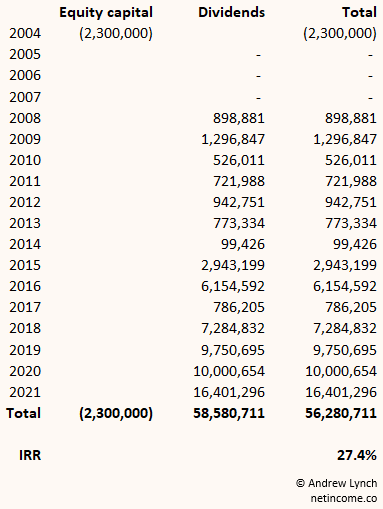
<p>I’m not assuming any terminal value of the business, and I’m only counting dividends paid to shareholders as cash out. Neither of those are entirely true, but it allows us to calculate the IRR, the <strong>Internal Rate of Return</strong> on the acquisition:[</p>

<p><img src="https://substack-post-media.s3.amazonaws.com/public/images/9e244788-6991-417c-8256-979a83a42f64_383x509.png" alt="" /></p>

<p>A <strong>27.4% internal rate of return over 17 years.</strong>.</p>

<p>Not bad at all. And *they still own the business. *</p>

<p>Serif today has averaged around £14m per year in EBITDA, so assuming the EBITDA multiple stays constant at 5.6x, **I estimate the business is worth £76.5m today. **</p>

<p>And realistically, that multiple is a lot higher now than it was then – it’s a much bigger, more profitable, more resilient business, all of which would drive the multiple up.</p>

<p>If we wanted to pull out another investment analysis technique, we can use a <strong>Discounted Cash Flow (DCF) model</strong>.</p>

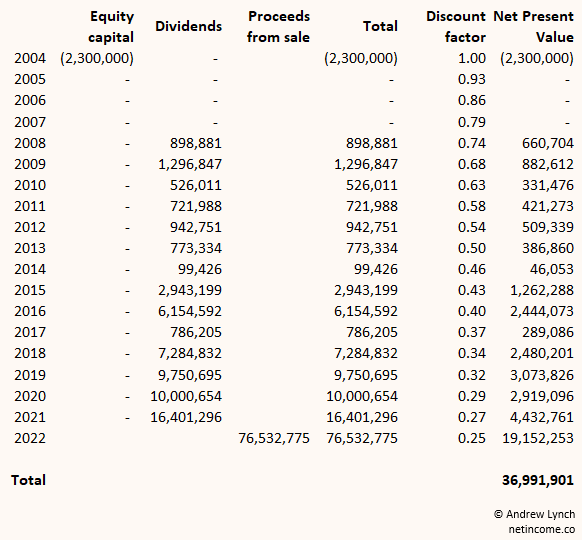
<p>Again, we have perfect information here so it’s cheating a little, and again, I’m simply using equity capital out and dividends back in as the cash flows, but let’s see how it shakes out using an 8% discount rate. Let’s also throw in an assumption that they sold the business for that estimated £76.5m valuation (ignoring taxes) at the end of 2022 as well.[</p>

<p><img src="https://substack-post-media.s3.amazonaws.com/public/images/10667694-19f9-40c7-ae71-3c839aa40105_582x540.png" alt="" /></p>

<p>By acquiring Serif Group in 2004, <strong>Gary and James generated £37m of value for themselves.</strong> What a great decision.</p>

<p>By the way, to get the discount factors for this, I just googled “discount factor table” – these values essentially tell you what your £1 today is worth in the future at different interest rates. The higher the interest rate, the lower the discount factor, because in periods of higher interest rates, you should value money now more than money in the future.</p>

<h2 id="risk-free-investing"><strong>‘Risk-free’ investing?</strong></h2>

<p>The one thing I want to point out today is not that these two guys made a phenomenal investment – which they did – but that they made a *smart *investment, one in which there was asymmetric upside.</p>

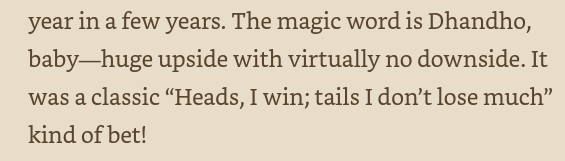
<p>It’s a great example of what investor <a href="https://amzn.to/471dulF">Mohnish Pabrai</a> calls a **Dhandho investment. **[</p>

<p><img src="https://substack-post-media.s3.amazonaws.com/public/images/60b70932-6998-4b43-8418-f3196912582c_565x161.png" alt="" /></p>

<p><em>Dhandho (pronounced dhun-doe) is a Gujarati word. Dhan comes from the Sanskrit root word Dhana meaning wealth. Dhan-dho, literally translated, means “endeavors that create wealth.”</em></p>

<p>*Pabrai, Mohnish. The Dhandho Investor *</p>

<p>Dhandho investing, as practised by Pabrai and others, is all about finding these ‘heads I win, tails I don’t lose too much’ scenarios.</p>

<p>That’s **exactly **what Gary Bates and James Bryce did when they acquired Serif in 2004. Here’s why.</p>

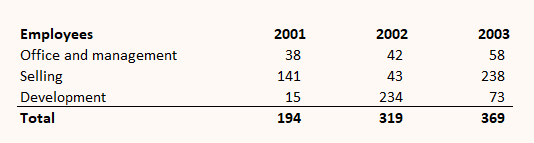
<p>On the face of it, splashing out £4.6m for a company that is at best mildly profitable seems foolish. But: remember the company had made pretty good money in 2001, but not much at all in 2002-03. That’s because they’d hugely increased headcount:[</p>

<p><img src="https://substack-post-media.s3.amazonaws.com/public/images/ac8a9d94-a137-483a-985d-1a1c34b70ec0_534x143.png" alt="" /></p>

<p>So Gary and James probably thought that in the worst-case scenario, they could run the Elon Musk playbook (decades ahead of Elon), lay off a bunch of people, get the company back to a reasonable level of profitability, and get their money back — or most of it, at least — in a few years.</p>

<p>Best-case scenario? They could invest in new products, hit upon one, and become very wealthy men.</p>

<p>Heads I win, tails I don’t lose too much. Classic Dhandho investing.</p>

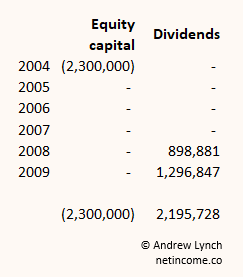
<p>In reality, by 2009 Serif had paid out enough in dividends that they’d essentially got back to breakeven on their initial investment:[</p>

<p><img src="https://substack-post-media.s3.amazonaws.com/public/images/537d4df0-630e-4322-bca4-60f3033c2aa2_243x277.png" alt="" /></p>

<p>Which meant everything after that was a freeroll, playing with house money. They could afford to take some swings. And swing they did, and it certainly paid off for them.</p>

<p>We’l leave it there for today — more to tell in this story next week, in particular:</p>

<p>-</p>

<h2 id="how-serif-completely-transformed-its-business-model">how Serif completely transformed its business model;</h2>

<p>and why they’ve only paid a total of £2.2m in tax on £64m of pre-tax profit over the last twenty years.</p>

<h2 id="carve-outs"><strong>Carve outs:</strong></h2>

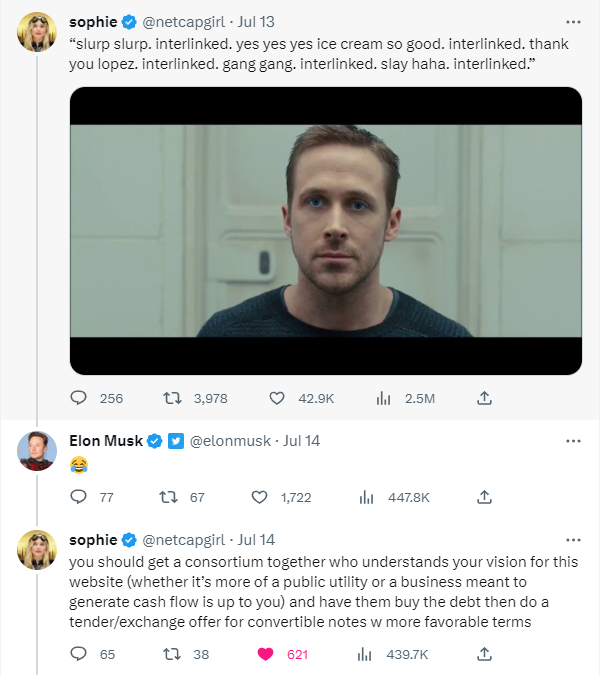
<p>Sophie, aka <a href="http://twitter.com/netcapgirl">@netcapgirl</a> on Twitter, had this incredible exchange with Elon Musk:[</p>

<p><img src="https://substack-post-media.s3.amazonaws.com/public/images/a7893fd6-520e-49ce-9f2b-062a517ef1fc_609x675.png" alt="" /></p>

<p>which she then expanded into this incredible analysis of Twitter’s LBO so far, and where they could go from here. Highly recommend it:[</p>

<p><img src="https://substack-post-media.s3.amazonaws.com/public/images/88f20b5c-e6de-40a6-afbc-6cef260e49f2_400x400.jpeg" alt="" /></p>

<p>Inevitability ResearchA Recap of Twitter’s LBOInevitability Research, Citrini&amp;junkbondinvestor Executive Summary: A convertible note private placement could allow Twitter to reduce debt burden from LBO by raising capital from investors aligned with long-term vision. This would lower interest costs and reduce bankruptcy risk…Read more3 years ago · 7 likes · 1 comment · Sophie, Citrini, and junkbondinvestor](https://www.inevitabilityresearch.com/p/a-recap-of-twitters-lbo?utm_source=substack&amp;utm_campaign=post_embed&amp;utm_medium=web)</p>

<p>Speak soon,</p>

<p>Andrew</p>]]></content><author><name></name></author><category term="net-income" /><summary type="html"><![CDATA[And some classic investment analysis techniques]]></summary></entry><entry><title type="html">Gymshark part 2: co-founder exits, billionaire tax planning, securing the bag, and cash crunches</title><link href="https://andrewlynch.net/blog/gymshark-part-2-co-founder-exits" rel="alternate" type="text/html" title="Gymshark part 2: co-founder exits, billionaire tax planning, securing the bag, and cash crunches" /><published>2023-07-13T00:00:00+00:00</published><updated>2023-07-13T00:00:00+00:00</updated><id>https://andrewlynch.net/blog/gymshark-part-2-co-founder-exits</id><content type="html" xml:base="https://andrewlynch.net/blog/gymshark-part-2-co-founder-exits"><![CDATA[<p><em><a href="https://netincome.substack.com/p/gymshark-part-2-co-founder-exits">Substack version</a></em></p>

<p>*Hello to the **97 new subscribers, **joining our happy family of **1,764 **business nerds for this week’s helping of P&amp;L paradise. I’m Andrew Lynch, a small business CFO and writer here in the UK, who one reader described as “the British Matt Levine?”, which I will keep quoting, without the question mark, until the day I die. *</p>

<p><em>Last week’s deep dive was a beastly 3,000 words about rocket-ship apparel business <strong>Gymshark</strong>, and the behind-the-scenes boardroom shenanigans along the way to reaching £500m/yr in revenue. This week, we’re back with — unebelievably — another 4,000 words on the topic, because Gymshark’s story is both educational and wonderfully salacious gossip.</em></p>

<p><em>As always: if you like this, <strong>please share it</strong> with a friend.</em></p>

<hr />

<p>Last week we looked at <a href="https://netincome.substack.com/p/the-boardroom-drama-behind-one-of">Gymshark’s blitzscale journey from a bedroom in Birmingham to a £500m/yr company</a>.</p>

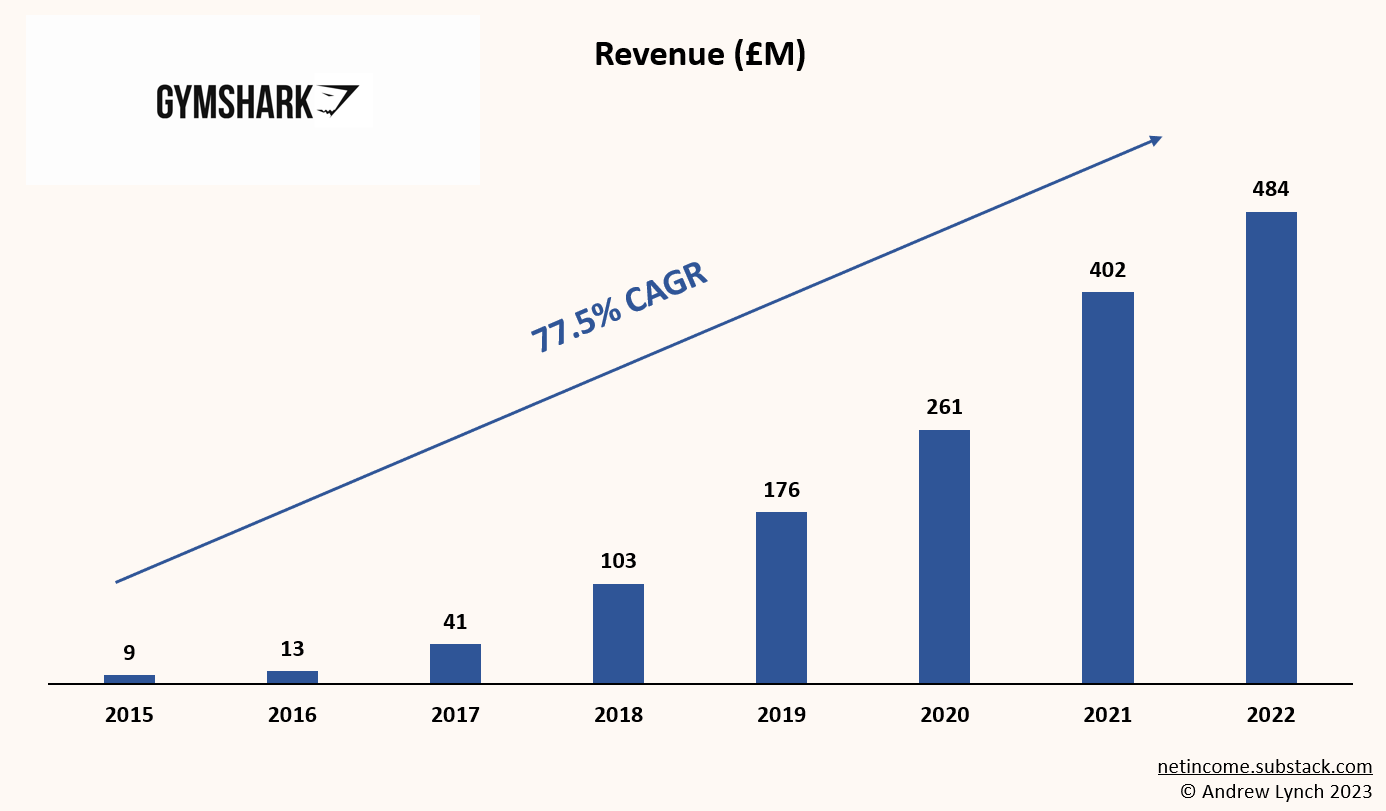
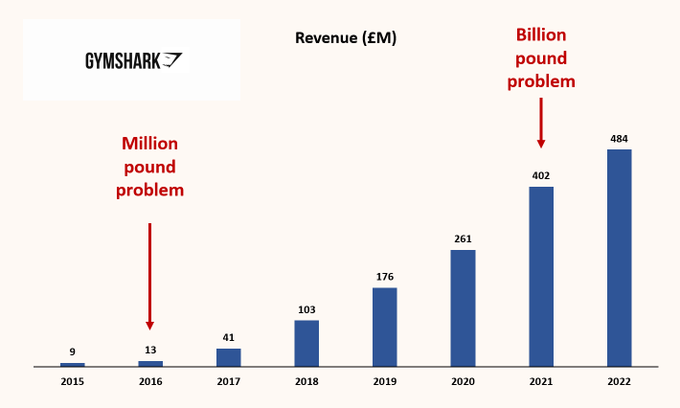
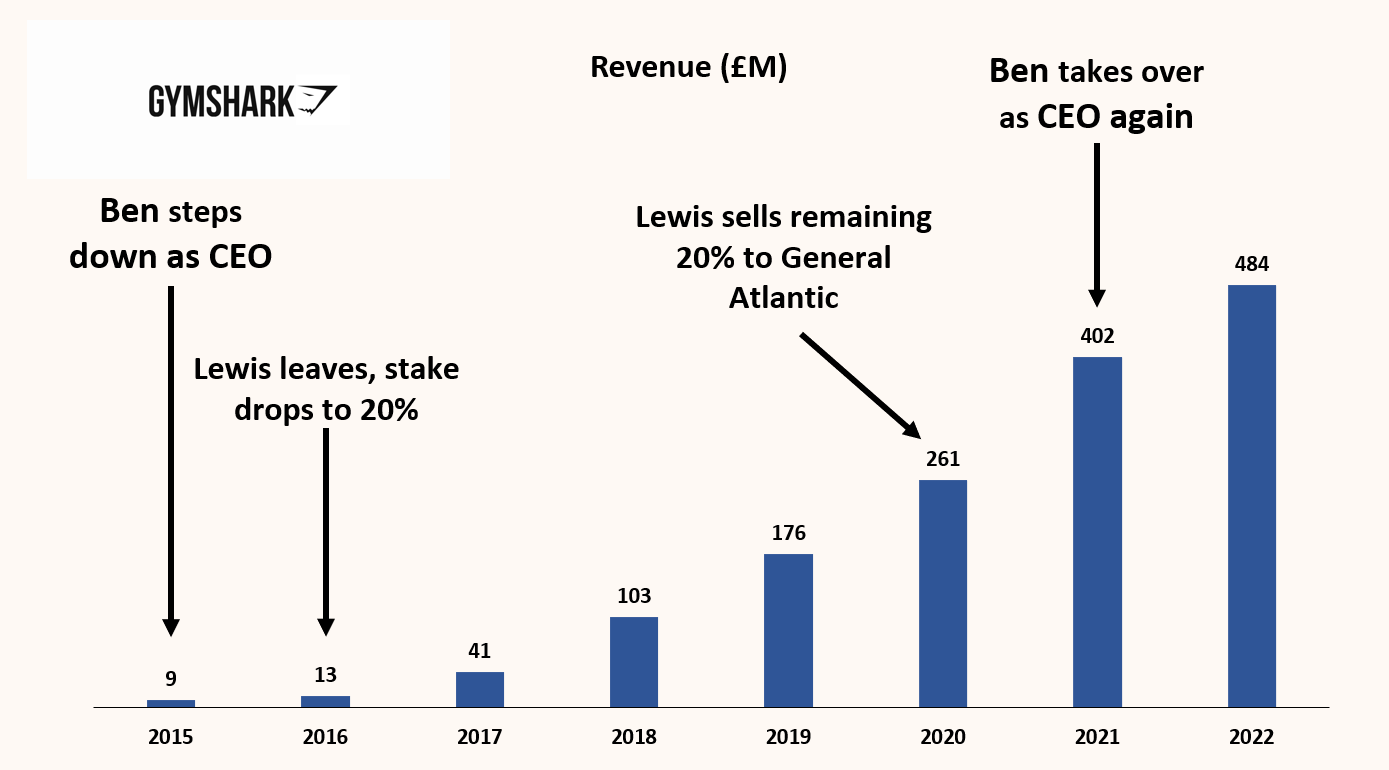
<p>As a recap, here’s Gymshark’s revenue since 2015. It’s a pretty stunning trajectory.[</p>

<p><img src="https://substack-post-media.s3.amazonaws.com/public/images/f511623d-0c0e-4a25-b2ea-058bbe61f45a_1386x811.png" alt="" /></p>

<p>And I dove into the Companies House filings to try and figure out what happened between Gymshark’s two co-founders, <strong>Lewis Morgan and Ben Francis</strong>, and why Morgan left the business in 2016.[</p>

<table>
  <tbody>
    <tr>
      <td>![Ben Francis</td>
      <td>Official Profile on The Marque](https://substack-post-media.s3.amazonaws.com/public/images/bf558f23-0486-4dc3-8c8b-1c0a98734a1c_864x864.jpeg)</td>
    </tr>
  </tbody>
</table>

<p><em>Gymshark CEO and co-founder Ben Francis, who wants you to know that he’s richer and more jacked than you’ll ever be.</em></p>

<p>And yes, I may have indulged in some minor libel and slander, as I insinuated that now-CEO Ben Francis deliberately and ruthlessly tried to cut out his co-founder to end up with a bigger piece of a rapidly growing pie. Look at him — he does *look *ruthless.</p>

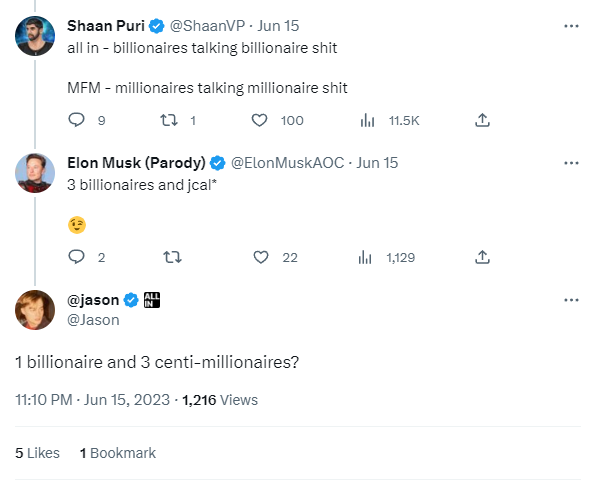
<p>And maybe that ruthlessness is the difference between, as Jason Calacanis would say, a billionaire and a centimillionaire.[</p>

<p><img src="https://substack-post-media.s3.amazonaws.com/public/images/45754f84-1c69-4f4a-ba35-93e27059676c_592x482.png" alt="" /></p>

<p><em>“AKSHUALLY I’M A CENTIMILLIONAIRE” is cringe AF. Be better, Jcal.</em></p>

<p>But this week we look at the other side of the story, and consider:</p>

<p>-</p>

<h2 id="why-maybe-its-right-to-kick-out-a-co-founder">why maybe it’s right to kick out a co-founder;</h2>

<h2 id="how-ben-francis-has-made-several-hugely-important-decisions-to-help-gymshark-along">how Ben Francis has made several hugely important decisions to help Gymshark along;</h2>

<p>and how Gymshark has financed its rapid growth in the famously cash-hungry world of inventory-based businesses.</p>

<hr />

<p>Reminder: I put hours of research into these posts, and distil it down for your consumption. If you want more, you can grab the Excel model and charts I used in this post in the Net Income store:</p>

<p>-</p>

<h2 id="gymshark-model-and-analysis"><a href="https://net-income.myshopify.com/products/gymshark-excel-model?utm_source=copyToPasteBoard&amp;utm_medium=product-links&amp;utm_content=web">Gymshark model and analysis</a></h2>

<p><a href="https://net-income.myshopify.com/products/gymshark-powerpoint-presentation?utm_source=copyToPasteBoard&amp;utm_medium=product-links&amp;utm_content=web">Gymshark deck</a></p>

<p>You’ll be emailed the file as soon as you check out.</p>

<hr />

<p>We’ll start with <strong>co-founder disputes</strong>.</p>

<h2 id="maybe-its-right-to-kick-a-co-founder-out"><strong>Maybe it’s right to kick a co-founder out</strong></h2>

<p>This is how Ben described the co-founder split on the Diary of a CEO podcast:</p>

<blockquote>

</blockquote>

<p><em>There came a point where <strong>I had my vision, and I think [Lewis] had his vision</strong>. And I just want to be clear, I don’t think one is better than the other. <strong>It was just a difference of opinion</strong>. And to be fair to him, <strong>he had so many other interests in terms of investments and property and all these different things</strong>. So Lewis essentially left…</em></p>

<p>To me, that sounds reasonable. Differences of opinion between co-founders or early-stage employees do happen. <strong>A lot.</strong> And not just between, say, Mark Zuckerberg and the Winklevoss twins, or Mark Zuckerberg and Eduaro Saverin, or Mark Zuckerberg and literally anyone else he’s ever come into contact with.</p>

<p>In fact, one of my favourite companies, <a href="https://www.tiny.com/">Tiny</a>, buys internet businesses all the time, and co-founder buyout is one of their main sources of dealflow:[</p>

<p><img src="https://substack-post-media.s3.amazonaws.com/public/images/1829190f-c943-485a-9f37-c212f19f0dbf_1300x655.png" alt="" /></p>

<p><em>Pictured: huge co-founder argument about who has the weirdest size legs</em></p>

<p><strong>Ben and Lewis were just 19 when they founded Gymshark, **in 2012</strong>.** By 2015, they’d had some success, and had some money in their pocket too. In their shoes, I’d think I could do anything I set my mind to.</p>

<p>So maybe Lewis did just have other interests that he wanted to pursue.</p>

<p>For example, on his LinkedIn page, right under Gymshark, Lewis mentions founding Maniere De Voir in 2013, just a year after Gymshark was launched:[</p>

<p><img src="https://substack-post-media.s3.amazonaws.com/public/images/294a4621-7e4e-4958-82da-5a7894cf354d_631x390.png" alt="Image" /></p>

<p><a href="https://www.manieredevoir.com/">Maniere De Voir</a> is more fashion than gymwear, but still, it’s an apparel ecommerce business, just like Gymshark.</p>

<p>So it’s not, like, out of the realm of possibility that Lewis being involved in Maniere De Voir would create a conflict of interest with Gymshark.</p>

<p>Or not even a conflict of interest, but just a distraction. When you’re growing at the rate Gymshark was back then, you need all hands on deck just to keep the ship going in the right direction. I can see why if I was focusing on one business, and my co-founder — with an equal stake — was focusing on another, I’d be getting frustrated.</p>

<p><strong>But that’s not quite the whole story.</strong></p>

<p>Intriguingly, if we look at the initial statement of capital for Maniere De Voir, back in 2013, <strong>Morgan and Francis were each 25% shareholders</strong>. Reece Wabara, who was playing professional football for Doncaster Rovers at the time, held the other 50%.[</p>

<p><img src="https://substack-post-media.s3.amazonaws.com/public/images/ff3e217b-bc6f-47b6-b64f-2625d6b569b4_680x452.png" alt="Image" /></p>

<p>Maniere De Voir started trading, and did well. Not stunningly well like Gymshark, but well enough to keep going.</p>

<p>A couple of years later, <strong>in 2016, Lewis Morgan leaves Gymshark</strong>, in what sounds like acrimonious circumstances. As I highlighted last week, Lewis <a href="https://youtu.be/cByoqWLSEwY?t=1811">describes the split</a> very differently to how Ben does:</p>

<blockquote>

</blockquote>

<p><em>“He [Ben] wants to say we had different visions — <strong>if he wants to clear his own conscience by making himself believe that, then so be it…</strong></em></p>

<p><em>There’s <strong>a lot of skeletons in the closet</strong> that’ll never be spoken about because of contractual reasons…</em></p>

<p><em>Loads of <strong>nasty stuff</strong> went on behind closed doors though.”</em></p>

<p>But despite that nasty split, the pair remained partners in Maniere De Voir until 2018, at which point Ben either gave up his shares, or sold them to Reece Wabara — a full two years after Lewis has left Gymshark:[</p>

<p><img src="https://substack-post-media.s3.amazonaws.com/public/images/1cfefda1-19eb-4b31-832d-f259b6eceb05_784x375.png" alt="Image" /></p>

<p>And Maniere De Voir today is a wonderful company, doing over £30m in revenue, nearly £3m in net profit, with a total of £7.3m in retained earnings.[</p>

<p><img src="https://substack-post-media.s3.amazonaws.com/public/images/37ddb126-4b12-4051-8370-9dc8b306bd13_636x631.png" alt="Image" /></p>

<p>It’s no Gymshark, of course, but it’s a thriving small business. Over time Lewis has given more shares to Reece Wabara, so the business is now 83% owned by Wabara, and the remaining 17% by Lewis Morgan:[</p>

<p><img src="https://substack-post-media.s3.amazonaws.com/public/images/20c71c12-ba54-4867-9fd6-a885b84c7316_777x311.png" alt="Image" /></p>

<p>All this to say: <strong>yes, it looks perfectly plausible that both Lewis Morgan AND Ben Francis had other business interests when Morgan left Gymshark.</strong></p>

<p>Which means we have one potential explanation for what happened — but remember, I have zero insider knowledge or information, so this is all wild speculation to take with a pinch of salt.</p>

<p>The way Ben tells it, all the following things happened at roughly the same time in 2015:</p>

<p>-</p>

<h2 id="lewis-left-the-business-due-to-differing-visions">Lewis left the business due to differing visions</h2>

<h2 id="ben-meets-paul-richardson-former-all-saints-investor-and-director-at-the-gym">Ben meets Paul Richardson, former All Saints investor and director, at the gym</h2>

<h2 id="richardson-introduces-ben-to-steve-hewitt-a-former-reebok-exec">Richardson introduces Ben to Steve Hewitt, a former Reebok exec</h2>

<h2 id="ben-receives-some-360-feedback-from-his-leadership-team-that-makes-his-realise-hes-not-the-right-person-to-lead-gymshark-on-its-next-growth-phase">Ben receives some 360 feedback from his leadership team that makes his realise he’s not the right person to lead Gymshark on its next growth phase</h2>

<p>Ben asks Richardson to join Gymshark as Exec Chairman, and Hewitt becomes CEO.</p>

<p>That’s how, as we discussed last week, we ended up with Hewitt taking 5% of the company in October 2015:[</p>

<p><img src="https://substack-post-media.s3.amazonaws.com/public/images/48d4800a-b089-43e3-8d95-f0fb2d7187d6_727x284.png" alt="" /></p>

<p>That’s the version Ben tells for public consumption.</p>

<p><strong>A different interpretation of this story might be:</strong></p>

<p>Ben and Lewis are young, naive, somewhat distracted, 20-somethings full of ego and some money, and have a rocket ship business on their hands. They think they can do anything, and start creating other businesses like Maniere De Voir.</p>

<p>The pair then meet experienced businessmen Paul Richardson and Steve Hewitt, who tell them words to the effect of:</p>

<p><em>“What the fuck are you doing? Gymshark’s the golden goose, just don’t get distracted or fuck it up and you’ll both be rich — and we can help you.”</em></p>

<p><strong>And maybe Ben takes that message to heart — and Lewis doesn’t.</strong></p>

<p>Ben goes all-in on Gymshark, wholeheartedly, and swears to spend the next decade building an amazing company. Lewis wants to keep building other businesses too, and investing in property, and generally being a big swinging dick.</p>

<p>So between them, <strong>Ben, Steve Hewitt, and Paul Richardson realise they need to tackle that problem now, rather than later.</strong></p>

<p>Because if you’ve got a founder with a big stake in the business, who’s no longer engaged, no longer pulling their weight, and racking up conflicts of interest left, right, and centre, <strong>that’s a big problem</strong>. It needs to be dealt with as soon as possible, before the company gets too valuable, and dealing with the problem becomes too expensive.[</p>

<p><img src="https://substack-post-media.s3.amazonaws.com/public/images/3bcb9357-8300-4a12-b693-af597a9e4c0a_680x408.png" alt="Image" /></p>

<p>This is where <strong>we have to give Ben Francis a ton of credit.</strong></p>

<p>Driven by a singular vision to create an iconic British brand to rival Nike and Lululemon.</p>

<p>Smart enough and self-aware enough, even in his early 20s, to realise that he should bring on outside help, and step down as CEO.</p>

<p>Humble enough to then spend **6 years **in different roles, learning at the right hand of more experienced team members, before taking up the CEO mantle again in 2021:[</p>

<p><img src="https://substack-post-media.s3.amazonaws.com/public/images/e2d9e54a-23de-4ada-acc6-c52a1a797c71_301x325.png" alt="" /></p>

<p><em>No idea what he was doing Jul 18 to Aug 19 though…</em></p>

<p>I’ve spoken to a couple of people who know a bit about Gymshark, and the one thing they both mentioned was this:</p>

<p><strong>Ben Francis didn’t really know what he was doing. He didn’t have a clue how to actually run a business. But he knew enough to find the right people.</strong></p>

<p>Which is the entrepreneur’s job! That’s what entrepreneurship is: assembling the team, the resources, setting the vision, and driving the company forward towards that vision. It’s a classic story of <strong>who, not how.</strong></p>

<p>So driven by that vision, Ben did what he needed to do and removed the obstacle that could prevent Gymshark from becoming the company he knew it could:[</p>

<p><img src="https://substack-post-media.s3.amazonaws.com/public/images/0d4b27a2-ce07-47db-89b4-0d5c0f64bae1_680x156.png" alt="Image" /></p>

<p>and in exchange, he agreed to forfeit, or sell, his shares in Maniere De Voir in 2018:[</p>

<p><img src="https://substack-post-media.s3.amazonaws.com/public/images/789b014f-fb34-407b-bffa-774439cb92ed_770x397.png" alt="Image" /></p>

<p>at which point the two co-founders go their separate ways, both wealthy men.</p>

<p><strong>One, the relentless, focused, billionaire CEO of Gymshark.</strong></p>

<p>The other, a *mere *centimillionaire, investor, property magnate, and plenty more besides.</p>

<p>Just different visions. But look at this chart:[</p>

<p><img src="https://substack-post-media.s3.amazonaws.com/public/images/9108bb4b-a056-47b7-bb84-d2245e9fff36_1389x770.png" alt="Image" /></p>

<p>Looking at that, it’s hard to say that Ben made any wrong decisions, or that Lewis was hard done by — remember, he sold half his stake at the 2016 valuation, and the other half at the 2020 valuation, for a rumoured $200m.</p>

<h2 id="billionaire-level-tax-planning">Billionaire-level tax planning</h2>

<p>I’m starting to tire of fawning over two guys who are both younger, more ripped, and significantly richer than me, so we’ll round off with a couple of other interesting things I found out in my research that didn’t quite fit into the story we just told.</p>

<p>Firstly, <strong>Ben Francis has excellent tax advisors.</strong></p>

<p>I shared some of my research with a friend of mine who’s had some business success. In particular, she saw the shareholdings, with half of Ben’s stake held via **Francis Family Office Ltd **and saw something I didn’t:[</p>

<p><img src="https://substack-post-media.s3.amazonaws.com/public/images/e61cb797-a4ea-4572-878c-0eecb91399ed_541x218.png" alt="" /></p>

<p>Francis Family Office Ltd isn’t a mere holding company, it’s a <a href="https://www.saffery.com/insights/publications/family-investment-company/">family investment company</a>:</p>

<blockquote>

</blockquote>

<p><em>A Family Investment Company (FIC) is a bespoke vehicle which can be used as an alternative to a family trust. It is a private company whose shareholders are family members. A FIC enables parents to retain control over assets whilst accumulating wealth in a tax efficient manner and facilitating future succession planning.</em></p>

<p>The tax experts in the audience can correct me, but I believe this means:</p>

<p>-</p>

<h2 id="francis-can-gift-shares-in-the-fic-to-his-children-now">Francis can gift shares in the FIC to his children now;</h2>

<h2 id="those-shares-become-more-valuable-over-time-as-gymshark-distributes-dividends-to-the-fic-which-the-fic-does-not-pay-tax-on">Those shares become more valuable over time as Gymshark distributes dividends to the FIC, which the FIC does not pay tax on;</h2>

<h2 id="fic-invests-those-distributed-dividends-in-other-assets-over-time-increasing-the-value-of-the-shares-he-gifted-to-his-kids">FIC invests those distributed dividends in other assets over time, increasing the value of the shares he gifted to his kids;</h2>

<p>Assuming Francis survives for seven years after donating those shares, they become <strong>exempt from inheritance tax</strong>.</p>

<p>A wonderful bit of tax planning. The sort of thing I won’t bother doing unless this newsletter *really *takes off, but I like to know about anyway.</p>

<p>To top it off, there’s a nice human interest story in Gloucestershire Live about him buying a farm in the Cotswolds for his family:[</p>

<p><img src="https://substack-post-media.s3.amazonaws.com/public/images/be82f0f4-93f9-4b05-9a7f-334171618c15_1241x855.png" alt="" /></p>

<p>which sounds just lovely. So idyllic. Ben and his wife being the Gen Z influencers they are, they even released <a href="https://youtu.be/1ubO6Ry89HM?t=137">an announcement video</a> about it.</p>

<p>Is this just a case of a family wanting some space to retreat to in order to get away from the hustle and bustle of daily life?</p>

<p>No! It’s a tax thing.</p>

<p>Buying a farm means you benefit from <strong>Agricultural Property Relief</strong>. [</p>

<p><img src="https://substack-post-media.s3.amazonaws.com/public/images/4887d53b-df0a-4b94-9243-b81b47a55b97_831x148.png" alt="" /></p>

<p>Which again, means that <strong>when Francis dies and passes on the family farm to his kids, they won’t pay inheritance tax.</strong></p>

<p>Just remember that tax strategy every time you see a rich guy who, for some reason, owns a farm, despite having no farming knowledge, ability, or desire.[</p>

<p><img src="https://substack-post-media.s3.amazonaws.com/public/images/1ecb3b2a-0acb-48a5-8fc8-5a3a61360f17_1200x675.jpeg" alt="Jeremy Clarkson Show 'Clarkson's Farm' Renewed For Season 2 On Amazon –  Deadline" /></p>

<p><em>“This is one of the best tax planning strategies… in the WORLD.”</em></p>

<p>Or maybe they just want the farm to use as a set for a tremendously popular Amazon Prime show, I don’t know.</p>

<p>Lastly it’s worth pointing out that Francis Family Office Ltd took a big chunk of Ben’s shares as part of General Atlantic’s investment in 2020, valuing their 35.5% of the company at £407.5m (implying an overall Gymshark valuation of £1.15bn):[</p>

<p><img src="https://substack-post-media.s3.amazonaws.com/public/images/0e384702-3cbe-4c2c-b89e-b4495fa84233_382x219.png" alt="" /></p>

<p>But between June 2020 and July 2021 they sold off £25.2m of that stake:[</p>

<p><img src="https://substack-post-media.s3.amazonaws.com/public/images/d53f56d6-9a9c-4426-b6f5-82b87df4f92d_616x287.png" alt="" /></p>

<p>Meaning that Ben Francis has very much <strong>secured the bag</strong>.</p>

<p>Gymshark could go to zero tomorrow, and he’ll still be a rich man. Not billionaire rich, or even centimillionaire rich, but he’ll have enough to retire to his (tax-efficient) Cotswolds farm and live out his days in peace.</p>

<h2 id="managing-cash-in-a-growing-business"><strong>Managing cash in a growing business</strong></h2>

<p>I say this as someone who works in an inventory-based business: <strong>managing cash flow is brutal, especially when you’re growing rapidly.</strong></p>

<p>Every penny you get from customers ends up being reinvested into more inventory. Cash is often the key constraint on how quickly you can grow — imagine a scenario where you could sell 100,000 gym t-shirts next month, but you’ve only got the cash to pay for 50,000. Well, that means you can only buy 50,000, which means you can only sell 50,000. Once you’ve collected the cash from those sales, you can buy more t-shirts.</p>

<p>The time it takes to turn money spent with your supplier into money in your own bank account is called your <strong>cash conversion cycle</strong>.</p>

<p>Cash conversion cycle =</p>

<p>Inventory days + Receivables Days - Payables Days</p>

<p><strong>Managing this cycle is one of the most important parts of running an inventory business.</strong></p>

<p>The perfect scenario would be getting credit terms from your supplier, buy the whole 100,000 t-shirts, sell them all, collect the money, and then finally pay the supplier. If you can get paid before you have to pay for things, that’s a <strong>negative cash conversion cycle</strong>, and it means your customers are funding your growth.</p>

<p>That’s what Gymshark was doing back in the day. This article, rather unimaginatively, is called <a href="https://www.menabytes.com/gymshark-negative-cash-conversion-cycle/">How Gymshark used negative cash conversion cycles to build a billion-dollar business</a>, and suggests <strong>Gymshark had a cash conversion cycle of minus 36 days:</strong>[</p>

<p><img src="https://substack-post-media.s3.amazonaws.com/public/images/5d76b13e-6dfc-49f9-a820-9fa381179159_875x454.png" alt="" /></p>

<p><em>My true love: a waterfall chart.</em></p>

<p>This writer claims these figures come from Gymshark’s financial statements. So, following in the footsteps of former US president Ronald Reagan, I adopted the mantra of “trust but verify,” I decided to dig into the numbers myself.</p>

<p>I couldn’t match up these numbers exactly, but I got close to the overall number using the figures from Gymshark’s 2016 financials:[</p>

<p><img src="https://substack-post-media.s3.amazonaws.com/public/images/eabb0c7b-102d-476b-838a-27812f015948_395x164.png" alt="" /></p>

<p>Looking at the 2016 figures, Gymshark was being paid on average 3.1 days after it sold the goods — which makes sense, it’s a DTC business, so customers are paying by credit or debit card at point of sale. No credit risk there (and my guess is the 3 days is the approx. time it takes the cash to clear from the card processor into Gymshark’s bank account).</p>

<p>More importantly, Gymshark looks to be holding inventory for only 81.6 days, and **paying for it **after 122.2 days — meaning that when they sell the inventory, they have another 40 days before they need to pay the supplier.</p>

<p>Wonderful! A negative cash conversion cycle, right?</p>

<p><strong>Well, things have changed.</strong>[</p>

<p><img src="https://substack-post-media.s3.amazonaws.com/public/images/e65711f4-41d8-4f85-9c7b-9eece17348b8_653x665.png" alt="" /></p>

<p>Since then, Gymshark’s cash conversion cycle has gotten continually longer and longer, every year. It’s now at <strong>102 days.</strong></p>

<p>Now, that might down to a couple of things:</p>

<p>-</p>

<h2 id="international-expansion-and-dealing-with-a-global-supply-chain">International expansion, and dealing with a global supply chain</h2>

<h2 id="a-deliberate-choice-to-make-sure-they-keep-up-with-sales-growth">A deliberate choice to make sure they keep up with sales growth</h2>

<p>Stockpiling inventory to make sure they never run out</p>

<p>Or, it could be that they’re just getting less and less efficient as a business. I don’t know.</p>

<p>So if they’re not funding their growth through a negative cash conversion cycle, and they only recently took outside money, how did they fund their growth?</p>

<p><strong>Debt.</strong></p>

<p>In the UK, when a company takes out a secured line of credit with a bank, it goes on Companies House as a <strong><em>registered charge</em></strong>**. **It’s so other lenders can credit check a company and see what assets are already pledged as security against other loans.</p>

<p>Here is a list of all the charges for Gymshark’s different entities:[</p>

<p><img src="https://substack-post-media.s3.amazonaws.com/public/images/12c38e22-932a-4eaa-9595-198c8670d990_909x234.png" alt="" /></p>

<p>Going back as far as 2015, they’ve taken out debt to fund growth. That’s fine — the company is profitable, and hasn’t had a problem servicing this debt. No doubt it comes with various conditions, covenants, and more, but for now, Gymshark hasn’t had any issues meeting those covenants.</p>

<p>That’s good, because if for whatever reason they fell into trouble, <strong>HSBC could take the keys to the kingdom</strong>.</p>

<p>As a reminder, this is Gymshark’s corporate structure:[</p>

<p><img src="https://substack-post-media.s3.amazonaws.com/public/images/ac3f323a-0e55-4ed0-87e9-482eab5bb25e_1084x778.png" alt="" /></p>

<p>And against its line of credit, <strong>Gymshark Group has pledged 100%</strong> <strong>of its shares of Gymshark Holdings as security. Gymshark Holdings has also pledged 100% of its shares of Gymshark Ltd.</strong></p>

<p>Here’s the schedule from the registration of charge:[</p>

<p><img src="https://substack-post-media.s3.amazonaws.com/public/images/96077636-4a50-4f50-ba2a-d17d9e00bd4e_615x308.png" alt="" /></p>

<p>Now, that’s not necessarily an issue — as long as Gymshark can keep servicing the line of credit and meet its covenants. But this is a £50m line of credit we’re talking about, and they’ve drawn down every penny of it:[</p>

<p><img src="https://substack-post-media.s3.amazonaws.com/public/images/c563307d-606f-4226-a7f5-bb6edbb03fbf_659x978.jpeg" alt="Image" /></p>

<p>And their net borrowing increased by — you guessed it — nearly £50m in their last financial year:[</p>

<p><img src="https://substack-post-media.s3.amazonaws.com/public/images/334b2693-e640-4ea9-a00f-520d5aae97cc_696x538.png" alt="" /></p>

<p>They needed that money to finance the <strong>£49m increase in inventory in the year,</strong> which, along with some unfavourable exchange rate movements, is the main reason their cash flow from operating activities was negative £32m:[</p>

<p><img src="https://substack-post-media.s3.amazonaws.com/public/images/10b3b4d0-6114-490e-9d03-bcfdd85d9c04_707x439.png" alt="" /></p>

<p>Again, none of this is necessarily an issue as long <strong>as the company is able to service the debt and meet its covenants</strong>.</p>

<p>On the face of it, Gymshark still has plenty of working capital to service the debt:[</p>

<p><img src="https://substack-post-media.s3.amazonaws.com/public/images/614885b2-ca7f-463b-a432-35922c28019a_546x212.png" alt="" /></p>

<p>But its <strong>cash conversion cycle is getting longer and longer</strong>. In particular, Gymshark has a lot of cash tied up in inventory. If we exclude inventory from the working capital calculation, things look a lot worse:[</p>

<p><img src="https://substack-post-media.s3.amazonaws.com/public/images/f35dc1cf-0b16-47fc-8f76-9d7b7c1233d3_534x228.png" alt="" /></p>

<p>Ouch. That’s why the debt is needed, to finance that negative working capital.</p>

<p>But <strong>as long as sales keep coming in, things will be fine.</strong></p>

<p>On to the final piece of the puzzle.</p>

<h2 id="has-gymshark-peaked">Has Gymshark peaked?</h2>

<p>Gymshark’s growth is certainly slowing. Here’s their year-over-year revenue growth since 2016:[</p>

<p><img src="https://substack-post-media.s3.amazonaws.com/public/images/02301ce7-91f5-402e-93dc-e2313b009505_648x421.png" alt="" /></p>

<p>You could argue that this is just an issue of scale — there are only so many people that want fancy workout gear, right? But remember last week we compared Gymshark to other brands in its category.</p>

<p><strong>Lululemon is 13x the size of Gymshark, doing $8bn in annual revenue, and still growing at a faster rate:</strong>[</p>

<p><img src="https://substack-post-media.s3.amazonaws.com/public/images/978d4e8e-01b8-45a1-bda0-514c2b152b78_1155x898.png" alt="" /></p>

<p>We can also dive into some of the commentary in Gymshark’s financials to learn more.</p>

<p>Firstly, they disclose that units sold grew by 27.5% in the year, and 63% in 2021:[</p>

<p><img src="https://substack-post-media.s3.amazonaws.com/public/images/d8bc6195-034f-4b57-a6e6-abacbd49125e_612x143.png" alt="" /></p>

<p>but remember, revenue only grew by 20.5% in 2022, and 54% in 2021.</p>

<p>So if unit growth is outstripping revenue growth, that means <strong>the average selling price per unit sold is dropping.</strong></p>

<p>In fact, in the last two years, the average selling price per unit is down 10.7%:[</p>

<p><img src="https://substack-post-media.s3.amazonaws.com/public/images/62b13b7a-dbb3-4cb8-8506-de24deb96527_714x579.png" alt="" /></p>

<p>A bunch of Gymshark’s sales are international and priced in USD, so that price decrease might just reflect adverse exchange rate movements. It could also be a deliberate strategy as they increase their unit volume with suppliers, driving down their buying price, and passing the savings on to their customers.</p>

<p>Overlaying Gymshark’s gross margin onto this average price per unit tells us it’s a bit of passing on savings, and a bit of margin compression too. Between 2020 and 2022, average sales price per unit is down 10.7% , and gross margin has dropped by only 4.0%, implying that <strong>the other 6.7% is cost savings passed on to customers:</strong>[</p>

<p><img src="https://substack-post-media.s3.amazonaws.com/public/images/3c926e8b-cace-47ea-9fb0-a8909f19ae4f_1017x611.png" alt="" /></p>

<p>Not too bad then.</p>

<p>The only other worry is that the drop in selling price per unit, and the fall in gross margin, coincides with the <strong>big increase in inventory.</strong></p>

<p><strong>The concern here is that sales are slowing, inventory is accumulating, and Gymshark is having to discount to get rid of that inventory, possibly in order to meet debt covenants or solve cash flow issues.</strong></p>

<p>This possible cash crunch is coming at the exact time that Gymshark are expanding into retail and wholesale — albeit only tentatively for now — which will both a) increase their receivables days, making their cash conversion cycle longer; and b) decrease their gross margins.[</p>

<p><img src="https://substack-post-media.s3.amazonaws.com/public/images/6ecc5b2b-f3c1-40f8-b6b1-40be1e1e698f_660x233.png" alt="Image" /></p>

<p>In their 2022 financials, Gymshark also hint at the revenue trajectory for 2023 year to date:[</p>

<p><img src="https://substack-post-media.s3.amazonaws.com/public/images/06319c17-54b8-40c7-8e32-76986d5dab2c_601x122.png" alt="" /></p>

<p><em>“Revenue is tracking at the same level as for the corresponding period.”</em></p>

<p>In other words, <strong>revenue hasn’t grown at all this financial year.</strong></p>

<p>What does that mean for inventory levels? Cashflow? Ability to meet debt covenants?</p>

<p>No idea. But it looks like the stakes are higher than ever, and I’ll be watching closely to see how the company performs this year.</p>

<p>Of course, in the unlikely scenario that Gymshark runs out of cash, can’t meet its obligations, and HSBC take the keys, the co-founders will be just fine.</p>

<p>Remember <strong>Ben Francis has already sold off about £25m of his stake</strong>, and invested in his tax-efficient farm, among other things. Hence why he probably sleeps OK at night, and has a beaming smile.[</p>

<p><img src="https://substack-post-media.s3.amazonaws.com/public/images/b6870f34-c0d7-461c-a22e-8b741dedc1aa_800x800.jpeg" alt="Profile photo of Ben Francis MBE" /></p>

<p><em>The look of someone who has very much secured the bag.</em></p>

<p>The irony in that situation is that Lewis Morgan would have sold off his remaining 20% in 2020, at the absolute peak of the company’s growth trajectory and zero-interest-rate based valuation. He’d have played an absolute blinder. [</p>

<table>
  <tbody>
    <tr>
      <td>![Lewis Morgan</td>
      <td>LinkedIn](https://substack-post-media.s3.amazonaws.com/public/images/fe2fcfff-024e-40cc-92af-d7dc9dd548df_450x450.jpeg)</td>
    </tr>
  </tbody>
</table>

<p><em>Lewis Morgan: laughing all the way to the bank.</em></p>

<p><strong>Maybe being kicked out of Gymshark would be the best thing that ever happened to him.</strong></p>

<p>The story isn’t over yet. I’ll report back when the next financials are filed, which will be… April 2024.</p>

<p>Stay on the edge of your seat until then, OK?</p>

<h2 id="carve-outs"><strong>Carve outs</strong></h2>

<p>This Gymshark thing ended up being a ridiculously large amount of work over the last couple of weeks, so only one carve out this time. If you’re a fan of Net Income, you’ll undoubtedly enjoy <a href="https://open.spotify.com/episode/0Vdv5i250hF6EfzOTML9RE?si=jmmTFVnwTkW5V7zlskhcjw">this fantastic interview with Jeremy Giffon on Invest Like The Best</a>. Jeremy was the first employee and General Partner at the aforementioned Tiny, and has a ton of experience buying and selling wonderful internet businesses. A fascinating discussion that covers topics like:</p>

<p>-</p>

<h2 id="esoteric-opportunities-that-exist-in-private-markets">Esoteric opportunities that exist in private markets</h2>

<h2 id="how-misaligned-incentives-and-coordination-problems-create-special-situations-for-people-like-jeremy-to-invest-in">How misaligned incentives and coordination problems create special situations for people like Jeremy to invest in</h2>

<h2 id="compensation-advice-for-ceos">Compensation advice for CEOs</h2>

<p>Meeting your heroes</p>

<p>and much more. Highly recommend it. Listen <a href="https://open.spotify.com/episode/0Vdv5i250hF6EfzOTML9RE">here</a> or wherever you get your podcasts.</p>

<h2 id="support-net-income"><strong>Support Net Income</strong></h2>

<p>As a reminder, you can support Net Income by visiting the <a href="https://net-income.myshopify.com/">Net Income store</a> on Shopify to grab any of the models or slides used in this post, and other posts.</p>

<p>You can also <a href="https://buy.stripe.com/eVa7sv0qS7T6fgA7su">click here</a> to become a founding member of Net Income. Your support means a ton to me, and by signing up, you’ll get a host of other benefits, including first-look (and free) access to future courses, a monthly catch-up call with me, and access to the Net Income community.</p>

<p>Thanks. Until next week,</p>

<p><strong>Andrew</strong></p>]]></content><author><name></name></author><category term="net-income" /><summary type="html"><![CDATA[The rest of the Gymshark story, and where next from here?]]></summary></entry><entry><title type="html">The boardroom drama behind Gymshark, one of the UK’s fastest-growing companies</title><link href="https://andrewlynch.net/blog/the-boardroom-drama-behind-one-of" rel="alternate" type="text/html" title="The boardroom drama behind Gymshark, one of the UK’s fastest-growing companies" /><published>2023-07-06T00:00:00+00:00</published><updated>2023-07-06T00:00:00+00:00</updated><id>https://andrewlynch.net/blog/the-boardroom-drama-behind-one-of</id><content type="html" xml:base="https://andrewlynch.net/blog/the-boardroom-drama-behind-one-of"><![CDATA[<p><em><a href="https://netincome.substack.com/p/the-boardroom-drama-behind-one-of">Substack version</a></em></p>

<p><em>Hello to the <strong>1,667 people</strong> reading this, and a warm welcome to the <strong>144 new subscriber</strong>s since last week.</em></p>

<p><em>As a reminder, I’m Andrew Lynch, a small business CFO here in the UK. Net Income is a weekly breakdown of the interesting companies I find.</em></p>

<p><em>This week’s deep dive is a look at one of the UK’s fastest growing companies, <strong>Gymshark</strong>, and the drama, intrigue and behind-the-scenes moves that took place as the company scaled from £10m to £500m/yr.</em></p>

<p><em>One request: if you like this, <strong>please share it</strong> with a friend.</em></p>

<hr />

<p><strong>Note: this is part 1 of the Gymshark story, For part 2, <a href="https://netincome.substack.com/p/gymshark-part-2-co-founder-exits">click here</a>.</strong></p>

<p>What do Andre Agassi and Prince Harry have in common?</p>

<p>Aside from a slightly brattish demeanour and a receding hair line, I mean.</p>

<p>The answer I was thinking of is: <strong>they both used the same ghostwriter.</strong></p>

<p>Agassi’s wonderful, brutally honest memoir <em>Open</em>, and Prince Harry’s salacious, baffling, gossip-filled book *Spare *were both penned by the same man, <strong>JR Moehringer</strong>, a Pulitzer Prize winning writer.</p>

<p>Moehringer is also the man behind <em>Shoe Dog,</em> the autobiography of Nike founder Phil Knight, which in my mind is probably the best business book I’ve ever read.[</p>

<p><img src="https://substack-post-media.s3.amazonaws.com/public/images/3ad414fd-8fd1-48c9-be64-109c9fa7d7c6_787x720.jpeg" alt="Four Key Takeaways on Leadership from Shoe Dog, the Tale of Creating the  Nike Brand" /></p>

<p><em>Please, please do yourself a favour and go and grab a copy of this.</em></p>

<p>Most autobiographies suck because they give way too much time and space to the boring parts of the story:</p>

<p>-</p>

<h2 id="the-persons-family-history-going-back-five-generations-i-dont-care">the person’s family history going back five generations (I don’t care)</h2>

<p>what the person’s life is like now they’ve succeeded (boring)</p>

<p><em>Shoe Dog</em>, on the other hand, covers the interesting part that we all love to read: <strong>the drama.</strong></p>

<p>It’s full of stories about Knight’s hard times building Nike: disagreements with co-founders, his shortcomings as a leader, and constantly being broke in a cash-hungry business — all while pursuing a singular vision of what he wants the brand to be.</p>

<p>This week we’re looking at a company that now competes with Nike, and has just as much drama in its story: <strong>Gymshark.</strong>[</p>

<table>
  <tbody>
    <tr>
      <td>![Gymshark Sale Now Live</td>
      <td>Up To 60% Off Gymshark](https://substack-post-media.s3.amazonaws.com/public/images/e4d960a0-66b9-45ac-91de-572980798e2b_581x582.jpeg)</td>
    </tr>
  </tbody>
</table>

<p><em>Grrr. Angry logo.</em></p>

<p>Gymshark was founded by 19-year-old best friends <strong>Ben Francis and Lewis Morgan</strong> back in 2012, and since then their growth has been meteoric.</p>

<p>By 2016 the company was already doing £13m in revenue, and it’s been on an absolute tear since then, reaching nearly £500m of revenue in 2022.</p>

<p>[</p>

<p><img src="https://substack-post-media.s3.amazonaws.com/public/images/f511623d-0c0e-4a25-b2ea-058bbe61f45a_1386x811.png" alt="" /></p>

<p><em>So sexy.</em></p>

<p>Gymshark is now a unicorn, probably worth around $2bn, and it’s made its founders fabulously wealthy. It recently opened its first flagship retail store, in the heart of London, and growth continues at breakneck pace, with ambitions to continue to expand in the US and Asia.</p>

<p><strong>Ben Francis, MBE</strong>, is now 31, and continues to be CEO of Gymshark today, with a vision to create a truly iconic, global, British brand like Jaguar, Aston Martin, or Burberry, and in the process, to rival Lululemon, Nike, and Under Armour as a top-end sportswear company. [</p>

<table>
  <tbody>
    <tr>
      <td>![Ben Francis</td>
      <td>Official Profile on The Marque](https://substack-post-media.s3.amazonaws.com/public/images/bf558f23-0486-4dc3-8c8b-1c0a98734a1c_864x864.jpeg)</td>
    </tr>
  </tbody>
</table>

<p><em>He’s also hench and has a beautiful wife to go with his millions, so, I guess, good for him? I bet he doesn’t have a mildly popular substack though.</em></p>

<p><strong>Ben now owns 71% of the company, and is worth around £1bn</strong>.</p>

<p>Co-founder Lewis? He owns <strong>0% of the company</strong>, having resigned his role in 2016, and selling off his shares in 2020.</p>

<p>Don’t cry too much for him: <strong>he’s rumoured to have sold his shares for around £100-200m.</strong></p>

<p>But still: that’s only like a tenth of what his fellow co-founder Ben is worth.</p>

<p>What the hell happened? Let’s get into it.</p>

<h2 id="gymsharks-numbers">Gymshark’s numbers</h2>

<p>First, let’s dive into Gymshark’s P&amp;L.</p>

<p>From their founding in 2012, it took Gymshark just <strong>6 years to get to £100m in revenue</strong>, and they’ve continued to grow at a tremendous rate since then. Here’s their P&amp;L over the last five years:[</p>

<p><img src="https://substack-post-media.s3.amazonaws.com/public/images/a8c6b97d-7172-4012-bb9f-5d6686a7ab8e_1087x868.png" alt="" /></p>

<p>Now Gymshark is a business doing ~£500m per year in revenue, at **65% gross margins, **and net margins of 5-10% per year. Not only that, but it’s still growing revenue at more than 20% year-over-year.</p>

<p>Where does that put Gymshark in its mission to become a global sportswear brand?</p>

<p>Let’s compare it to the three brands that Ben Francis himself mentions: <strong>Nike</strong>, <strong>Lululemon</strong> and <strong>Under Armour</strong>.</p>

<p>In terms of revenue, it’s no surprise that Nike is the absolute behemoth of the industry, doing nearly $47bn a year in revenue.[</p>

<p><img src="https://substack-post-media.s3.amazonaws.com/public/images/51477665-1878-417b-80bd-3242c5405803_1019x816.png" alt="" /></p>

<p><em>Gymshark numbers converted into USD at $1.24 : £1. Just be grateful Liz Truss is no longer Prime Minster.</em></p>

<p>Of course Nike has had a 50 year head start on Gymshark, so it’s not really a fair comparison.</p>

<p>Lululemon is a better analogy — the company was founded in 1998, and after 10 years in business, Lululemon went public, and was doing $353m in revenue at the time. Adjusted for inflation, that’s about <strong>$500m in today’s money</strong>.</p>

<p>Which means that in terms of revenue, <strong>Gymshark is ahead of where Lululemon was at the same point in its journey.</strong></p>

<p>The flipside of that argument is that Lululemon then went on an absolute tear for 14 years, growing at a compounded rate of 25%, and now does over $8bn a year in sales:[</p>

<p><img src="https://substack-post-media.s3.amazonaws.com/public/images/25f6d17a-123e-4b7c-8f16-20ed6e99b691_1000x743.png" alt="" /></p>

<p>and while Gymshark is growing faster than Nike and Under Armour, Lululemon is <strong>still</strong> the leader of the pack:[</p>

<p><img src="https://substack-post-media.s3.amazonaws.com/public/images/978d4e8e-01b8-45a1-bda0-514c2b152b78_1155x898.png" alt="" /></p>

<p>which is all the more impressive when you consider that Lululemon’s revenue is more than 13x that of Gymshark.</p>

<p>Here I should declare a conflict of interest:</p>

<p><strong>I’m an unofficial brand ambassador for Lululemon.</strong></p>

<p>It’s a unilateral agreement that Lululemon HQ is unaware of, but it basically means I always wear their clothes and walk around telling people how amazing they are.</p>

<p>side note: yes, sponsorship slots are available! hmu lulu xx</p>

<p>One thing Gymshark has in its favour vs legacy brands is on gross margins. As a native DTC brand, Gymshark may pay eye-watering fees to Shopify, but it doesn’t have the same <strong>cost of physical retail stores</strong> that other brands do, meaning higher gross margins:[</p>

<p><img src="https://substack-post-media.s3.amazonaws.com/public/images/56abe851-fa11-4137-9a62-1ecfa48331ae_1154x886.png" alt="" /></p>

<p>but then again, being a DTC brand, if it’s not Shopify picking your pocket, it’s all that pesky sales and marketing expense, or the breakneck costs of rapid growth (although Lululemon still does fine).</p>

<p>The end result is that Gymshark has the lowest net margins of the comparison group.[</p>

<p><img src="https://substack-post-media.s3.amazonaws.com/public/images/a540d5d5-2df7-4b18-aadf-0452de5a7e80_836x610.png" alt="" /></p>

<p>Gymshark’s a great business, and if it can keep growing, it could definitely find itself in the same class as the comparison companies. It’s not there yet — but it’s done pretty damn well for business that only recently celebrated its 10th birthday.</p>

<p>It’s even more impressive when you consider the <strong>tumult and drama</strong> that Gymshark has gone through in its short history.</p>

<h2 id="key-lesson-pick-your-co-founders-carefully">Key lesson: pick your co-founders carefully</h2>

<p>Gymshark was founded by two best mates, Lewis Morgan and Ben Francis, back in 2012. Both keen fitness enthusiasts, they’d tried their hand at a couple of different business ideas in the gym and fitness space, none of which quite took off. Gymshark was another of these business ideas — it was originally intended to be online supplement store.</p>

<p>One day, so the story goes, Ben found himself frustrated at his inability to find good gym clothes that fit. (I’ve had the same problem because I’ve got such swole thighs. Seriously.)</p>

<p>So Ben and Lewis pivoted to making and selling gym clothes — and it worked! Instant traction.</p>

<p>At the time, Ben was working at Pizza Hut, making minimum wage, and sewing clothes in his parents’ garage, and he kept doing so until Gymshark had well over £100k in revenue, until finally Lewis and Ben both agreed to go full-time on Gymshark.</p>

<p>It’s right here, right at the beginning of the story, that <strong>the seeds of the drama are sown:</strong></p>

<p>1.</p>

<p>The two co-founders are best mates.
2.</p>

<p>Each co-founder had an equal 50/50 stake in the business.</p>

<p>“Let’s keep it simple,” they said. “We’ll split everything right down the middle.”</p>

<p>So they incorporated Gymshark Ltd. The company had two shares, and they each owned one of them:[</p>

<p><img src="https://substack-post-media.s3.amazonaws.com/public/images/3df75eb9-a4a3-4ad5-857f-063af9a0ac8a_637x604.png" alt="" /></p>

<p><em>Possibly the simplest cap table known to man.</em></p>

<p>They also, according to Ben, didn’t really have any structure or clear roles and responsibilities. When you don’t have a clear split of roles, and neither one of you can outvote the other, that’s a recipe for disaster and paralysis.</p>

<p>So what happened? Here’s an excerpt from a <a href="https://www.youtube.com/watch?v=K8UgjzJTdHw&amp;ab_channel=TheDiaryOfACEO">podcast interview</a> Ben did a couple of years ago:</p>

<blockquote>

</blockquote>

<p><strong><em>Interviewer: So what were you the CEO? Or were you both CEOs?</em></strong></p>

<p><em>Ben: No, in the early days, that never really happened. It was just a bit like, right, this is a list of things that we need to do. Let’s just tackle them as we go. There was no organisation in those days.</em></p>

<p><em>… in the early days, we were literally inseparable, and then there came a point where I had my vision, and he had his vision… <strong>so Lewis essentially left.</strong></em></p>

<p>Oh, OK. Just a difference of opinion over the direction of the company, and so Lewis decided to leave? Seems reasonable.</p>

<p><strong>But what does Lewis have to say on the matter?</strong></p>

<p>On a different <a href="https://youtu.be/cByoqWLSEwY?t=1811">podcast</a>, Lewis says:</p>

<blockquote>

</blockquote>

<p><em>“He [Ben] wants to say we had different visions — <strong>if he wants to clear his own conscience by making himself believe that, then so be it…</strong></em></p>

<p><em>There’s <strong>a lot of skeletons in the closet</strong> that’ll never be spoken about because of contractual reasons…</em></p>

<p><em>Loads of <strong>nasty stuff</strong> went on behind closed doors though.”</em></p>

<p>Oh dang. That sounds salacious. But we don’t know any more than that, and it’s possible we’ll never know any more. Curse you, non-disclosure agreements!</p>

<p>What we **can **do is track the shareholding changes over time. It’s time to put our detective hat on, and do some sleuthing.</p>

<h2 id="the-evolving-shareholder-list-of-gymshark">The evolving shareholder list of Gymshark</h2>

<p>As mentioned earlier, Gymshark started with a very simple structure: Ben and Lewis each owned one share.[</p>

<p><img src="https://substack-post-media.s3.amazonaws.com/public/images/304ad52a-d561-4cdf-8d32-4702fa4261ac_716x261.png" alt="" /></p>

<p>Couldn’t be simpler. Each share is worth £1, and vote. An easy 50/50 split of both voting and economic rights.</p>

<p>Over those first three years the co-founders grafted, and grew the business rapidly. By 2015 Gymshark was close to eight figures in revenue, around 35 employees, and looked set to keep expanding rapidly.</p>

<p><strong>The company was a rocket ship, and they all knew it.</strong></p>

<p>Which is why it’s incredibly surprising that at that point, as Ben Francis tells it, <strong>he decided to remove himself as CEO.</strong></p>

<p>Ben says he got some 360-degree feedback from his leadership team that made him realise **he wasn’t the leader he needed to be if Gymshark was going to fulfil its potential. **He subsequently stepped down to Chief Brand Officer, and appointed an external CEO above him.</p>

<p>To put it in context, Ben Francis was just 23 at that time. He and Lewis had built a company that by that time was doing about £9m a year in revenue. **And he decided to step down for the good of the company. **</p>

<p>Assuming that is indeed what happened, **I’ve got a huge amount of respect for that call. **That’s a level of maturity, self-awareness and humility I wouldn’t have had at that age.</p>

<p>So, enter **Steve Hewitt. **[</p>

<p><img src="https://substack-post-media.s3.amazonaws.com/public/images/ac4feeb4-2934-4996-b821-e6dbf70f6804_500x500.jpeg" alt="Profile photo of Steve Hewitt" /></p>

<p><em>Pretty awkward grin tbh.</em></p>

<p>Steve came to Gymshark with a pedigree in the sportswear industry, having served 6 years as Commercial Director (EMEA) for Reebok. Steve was appointed as a director of Gymshark Ltd in June 2015, taking on the CEO role — <strong>as well as 5% of the company for his troubles</strong>.</p>

<p>At the same time, in June 2015, <strong>Paul Richardson</strong>, former director of All Saints Retail<a href="#footnote-1">1</a>, is appointed a director of Gymshark too, taking on the Executive Chairman role — but Richardson doesn’t get any shares at this point.</p>

<p>After a cheeky little 100-1 share split, and the creation of a new share class, we find ourselves with this shareholder list by October 2015:[</p>

<p><img src="https://substack-post-media.s3.amazonaws.com/public/images/48d4800a-b089-43e3-8d95-f0fb2d7187d6_727x284.png" alt="" /></p>

<p>One important thing to note: <strong>Steve Hewitt’s shares are a different class, B shares, than Ben and Lewis’s A shares.</strong></p>

<p>This is pretty common. Often different share classes exist to assign different rights to each share class. Different share classes may have more or less power when it comes to shareholder votes, or dividends, or a claim on the company’s assets in the event of liquidation. That sort of thing.</p>

<p>In this instance, it’s so that holders of A shares (Ben and Lewis) had right of first refusal to buy B shares, which we can see in the filing docs:[</p>

<p><img src="https://substack-post-media.s3.amazonaws.com/public/images/6745501a-3b45-4e86-b20e-9603c9c6adde_584x133.png" alt="" /></p>

<p>This still all looks kosher to me. Ben and Lewis bring in an outside CEO — someone more mature, with industry experience, to help guide them — and give him some equity so that he’s got some skin in the game. But make that equity a different share class — just to make sure you get first right to buy his shares back, and you don’t risk losing control of the company. All makes sense.</p>

<p>Crucially, though, <strong>the B shares have the same voting rights as the A shares</strong>. Which mean if the two co-founders disagree, Steve Hewitt has the swing vote.</p>

<p><em>ominous music</em></p>

<p><strong>Then we hit September 2016.</strong></p>

<h2 id="the-great-restructure-of-2016">The great restructure of 2016</h2>

<p>According to Ben’s Instagram page, he was on a Gymshark world tour in Canada at the time when all hell broke loose in a matter of days.</p>

<p>On 17th September 2016:</p>

<p>-</p>

<h2 id="gymshark-holdings-ltd-is-formed-originally-named-the-clade-group-and-takes-100-ownership-of-gymshark-ltd-the-trading-company"><strong>Gymshark Holdings Ltd</strong> <strong>is formed</strong> (originally named the Clade Group), and takes 100% ownership of Gymshark Ltd (the trading company).</h2>

<p>**Ben Francis, Paul Richardson, and Steve Hewitt **are all named directors of Gymshark Holdings.</p>

<p>That same day Gymshark Holdings files its initial list of shareholders:[</p>

<p><img src="https://substack-post-media.s3.amazonaws.com/public/images/b297960e-d4d3-4471-a901-29a5a1c687f8_750x758.png" alt="" /></p>

<p><strong>and Lewis Morgan’s name is nowhere to be seen.</strong></p>

<p>We see from Gymshark Ltd’s filing in January 2017 that all shares of Gymshark Ltd had been transferred to Gymshark Holdings (aka Clade Group):[</p>

<p><img src="https://substack-post-media.s3.amazonaws.com/public/images/29ee3256-c05e-48e7-8e28-c2a0aab8b173_777x511.png" alt="" /></p>

<p>So we know that on 17th September 2016, the ownership structure of Gymshark looked like this:[</p>

<p><img src="https://substack-post-media.s3.amazonaws.com/public/images/3384e040-26f2-4874-82d1-6fbbfd8810fe_727x478.png" alt="" /></p>

<p>Four days later, on 21st September 2016, a new list of shareholders for Gymshark Holdings gets filed, and Lewis is back on the list:[</p>

<p><img src="https://substack-post-media.s3.amazonaws.com/public/images/74e102ec-ef42-4f1f-bacb-2dd45c9638a2_752x497.png" alt="" /></p>

<p>But his shareholding is now only 20%, down from the 47.5% he previously held. Ben Francis increases his stake to 67%, and Paul Richardson swoops in with a cheeky 6% of the company too:[</p>

<p><img src="https://substack-post-media.s3.amazonaws.com/public/images/29b80412-47a8-4980-8525-819766f00212_681x284.png" alt="" /></p>

<p><strong>That same day, Lewis Morgan resigns as a director of Gymshark Ltd.</strong>[</p>

<p><img src="https://substack-post-media.s3.amazonaws.com/public/images/81701154-d340-49a6-92f8-698043649520_576x260.png" alt="" /></p>

<p>And, y’know, maybe this is all a coincidence, but this happened to be the financial year in which <strong>Gymshark tripled revenue</strong>, and made nearly £10m in net profit, more than it had in all its previous years combined.</p>

<p>[</p>

<p><img src="https://substack-post-media.s3.amazonaws.com/public/images/0bb8759b-a727-4ecb-a362-e87b1fdc67df_586x490.png" alt="" /></p>

<p>It’s possible that Lewis Morgan’s equity stake went down **simply because he sold his shares. **I can’t see evidence of that anywhere particularly — but if it was a private transaction between the shareholders, we wouldn’t see it.</p>

<p><strong>But why would you hugely reduce your stake in a business when you know its value is about to skyrocket?</strong></p>

<p><strong>You wouldn’t.</strong></p>

<p><strong>Surely, you wouldn’t?</strong></p>

<p>So it frustrates me to have to say this, because I hate throwing shade on successful British companies.</p>

<p><strong>But it’s entirely possible that Lewis Morgan was forced out of Gymshark by Ben Francis, Steve Hewitt, and Paul Richardson.</strong></p>

<p>Maybe Lewis Morgan got the full Eduardo Saverin treatment.[</p>

<p><img src="https://substack-post-media.s3.amazonaws.com/public/images/26aec807-b7d3-437b-ae6f-8ccaf34f49ca_700x525.png" alt="Andrew Garfield Responds to Thirst Tweets, Discusses 'Social Network'" /></p>

<p><em>Saverin would later go on to sling web and fight crime in New York city, or something.</em></p>

<p>For four days, between 17th and 21st September 2016, Lewis Morgan appeared to have no stake in Gymshark at all. Or at the very least, it looks like Ben Francis, Steve Hewitt and Paul Richardson were forming a separate holding company without him.</p>

<p>Why?</p>

<p>Maybe it’s just a filing issue or a timing issue with Companies House — it’s entirely possible that Lewis just sold a big chunk of his stake to the other shareholders, including Ben, at a fair price.</p>

<p>Or maybe Lewis wasn’t pulling his weight and Ben and Steve did what they thought was right for Gymshark, which was to get rid of him.</p>

<p>Or maybe they used this restructure to somehow threaten Lewis to force him to sell his shares to them at a deep discount?</p>

<p>I really have no idea what the truth is here. <strong>But I love the drama.</strong></p>

<h2 id="the-resolution">The resolution</h2>

<p>The morally ambiguous ending to this tale comes in August 2020, when private equity house General Atlantic plonks down a cool £200m to acquire 21.1% of Gymshark. [</p>

<p><img src="https://substack-post-media.s3.amazonaws.com/public/images/72971ae6-bfd5-4bb2-90e9-770cb3904320_787x115.png" alt="" /></p>

<p>As part of the deal, co-founder Lewis Morgan sells his remaining stake for somewhere in the region of £100-200m. We don’t know exactly how much. But in the press release around the sale, his name doesn’t even get a mention:[</p>

<p><img src="https://substack-post-media.s3.amazonaws.com/public/images/8fb888b6-e983-4d3a-a20f-91c6ba7d018f_682x77.png" alt="" /></p>

<p>Today the shareholder list is basically the same as it was following that transaction.</p>

<p>The only difference is that Ben Francis gave a big chunk of voting shares to his brother, which includes 1% economic ownership of the company. Ben also transferred half of his ownership stake into Francis Family Office Ltd (which Ben Francis owns 100% of personally):[</p>

<p><img src="https://substack-post-media.s3.amazonaws.com/public/images/e61cb797-a4ea-4572-878c-0eecb91399ed_541x218.png" alt="" /></p>

<p>Based on that valuation of $1.3bn — a valuation agreed in 2020, so make your own judgement about which way it’s gone since then — <strong>Ben Francis himself is worth around $900m</strong>.</p>

<p>In 2021, he felt he was ready to take the CEO seat back off Steve Hewitt, who moved into a non-exec chairman role.</p>

<p>And in 2023, Ben Francis was awarded an MBE. [</p>

<p><img src="https://substack-post-media.s3.amazonaws.com/public/images/8210f051-ac10-4dbf-bf66-506dcaed9deb_615x447.jpeg" alt="Youngest UK billionaire Ben Francis' rise from parents' garage to Gymshark  fortune - Mirror Online" /></p>

<p>Now, he even gets to do <strong>fun rich people stuff</strong>, like take £10m of his own money that’s been distributed out of Gymshark to his family office co, and lend it back to them at a 3% premium to the SONIA rate:[</p>

<p><img src="https://substack-post-media.s3.amazonaws.com/public/images/be018e5a-f134-4d43-93d8-5339979acb7c_655x108.png" alt="" /></p>

<p>which, given the SONIA rate of ~5% per year, plus the 3% premium, means he’s <strong>making the best part of £1m a year just in interest</strong>! Isn’t being rich fun?</p>

<p>All you need to do is ruthlessly cut out your co-founder and best mate from the deal, and you’re golden.</p>

<p>This guy knows what I’m talking about:[</p>

<table>
  <tbody>
    <tr>
      <td>![Mark Zuckerberg’s New Year Plan to Run 365 Miles</td>
      <td>Time](https://substack-post-media.s3.amazonaws.com/public/images/90836a15-2c21-456b-b1b7-ee0a0e049ccf_4188x3092.jpeg)</td>
    </tr>
  </tbody>
</table>

<h2 id="gymshark-part-2-next-week">Gymshark part 2, next week</h2>

<p>There’s actually a bunch more in the Gymshark story that I want to talk about — bringing in external talent, identifying your best role in the business, managing working capital in a brutally cash-hungry business like ecommerce — so we’ll be doing a Gymshark part 2 next week as well.</p>

<p>But with Succession finished for good, I was looking for a slice of boardroom action, and I just couldn’t resist diving into this side of the Gymshark story.[</p>

<p><img src="https://substack-post-media.s3.amazonaws.com/public/images/807a7d99-062d-40be-87c3-9a52ee0d8363_498x294.gif" alt="Its All The Drama Mick GIF - Its All The Drama Mick I Just ..." /></p>

<p>Speak soon.</p>

<p>Andrew</p>

<p>EDIT: part 2 is out! <a href="https://netincome.substack.com/p/gymshark-part-2-co-founder-exits">Head here to read more about co-founder exits, billionaire tax planning, securing the bag, and cash crunches</a>.<a href="#footnote-anchor-1">1</a></p>

<p>Or so he says. I actually can’t find any record of Paul Richardson ever being a director of All Saints Limited. He’s not on <a href="https://find-and-update.company-information.service.gov.uk/company/04096157/officers">the list of directors past and present</a> at Companies House, for example.</p>]]></content><author><name></name></author><category term="net-income" /><summary type="html"><![CDATA[Haven't we seen this movie before?]]></summary></entry></feed>